Guestbook Entry for Sushil Manchikatla, United States
Name
Sushil Manchikatla
Country
United States
State
Illinois


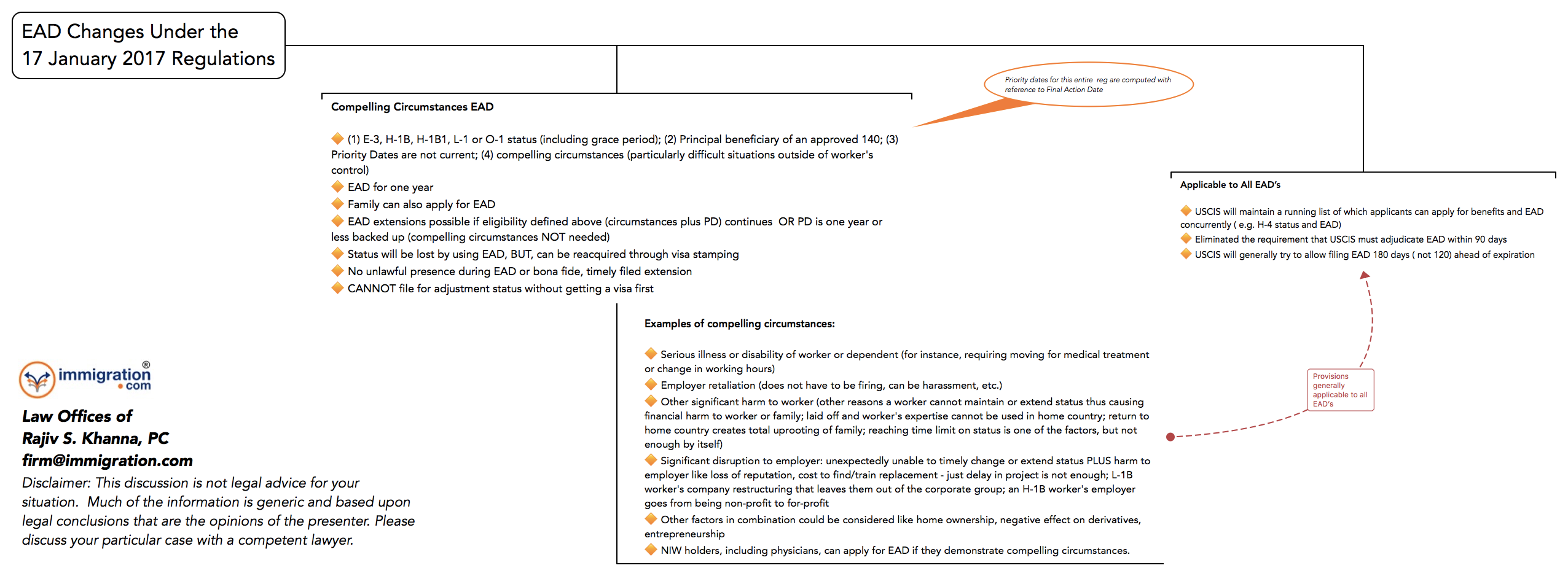
This entry is now old law. The new law is at http://www.immigration.com/blogs/i-140-ead-regulations-effective-17-jan…
Note: Updated all of the regulations comments on 31 December 2015. I will keep adding, as needed.
The Department of Homeland Security (DHS) amended its regulations today to improve the programs serving the H-1B1, E-3 and CW-1 nonimmigrant classifications and the EB-1 immigrant classification, and remove unnecessary hurdles that place such workers at a disadvantage when compared to similarly situated workers in other visa classifications.
The Department of Homeland Security (DHS) amended its regulations today to improve the programs serving the H-1B1, E-3 and CW-1 nonimmigrant classifications and the EB-1 immigrant classification, and remove unnecessary hurdles that place such workers at a disadvantage when compared to similarly situated workers in other visa classifications.
US Work and Immigration Options for Foreign Professionals
The E-3 visa allows for the admission of an alien who is a national of the Commonwealth of Australia and who is entering the U.S. to perform services in a “specialty occupation.” The E-3 visa has many advantages over the other types of working visas, including the ability for spouses of E-3 recipients to apply for work authorization.
We assisted in responding to an RFE questioning the employer’s educational requirements for an E-3 (Specialty Occupation Workers from Australia) Petition filed for a software developer position. USCIS sought clarification as to how the position could be a specialty occupation where the employer required a minimum of a bachelor’s degree in business, information systems, computer science or equivalent with related experience.
We assisted in responding to an RFE questioning the employer’s educational requirements for an E-3 (Specialty Occupation Workers from Australia) Petition filed for a software developer position. USCIS sought clarification as to how the position could be a specialty occupation where the employer required a minimum of a bachelor’s degree in business, information systems, computer science or equivalent with related experience.
Release Date
03/18/2022
U.S. Citizenship and Immigration Services is updating guidance in the USCIS Policy Manual to address the documentation that certain E and L nonimmigrant spouses may use as evidence of employment authorization based on their nonimmigrant status.
E Visa company registrations - It is advisable for “E” visa companies to update “registration” files at post every year although there is no specific regulation.
Following-to-Join for adjustment cases - An applicant who is the principal alien and whose spouse or child now needs to follow to join can now continue to deal directly with posts in paths:
1
. Immigrant visa at the same post as the one where the following-to-join will process;
The Office of Foreign Labor Certification has posted new and updated Labor Condition Application (LCA/ ETA Form 9035/9035E) Frequently Asked Questions (FAQs) for the H-1B, H-1B1 and E-3 programs.
For the new FAQs click here.
USCIS recently published an update to the following forms and supplements:

Radio Show Discussing Overview of the new I-140 EAD Regulations
Discussing I-140 EAD FAQ in community conference call
We were retained by a corporate client to process several E-3 petitions for nationals of Australia. All of the visas were issued at the Australian consulates without any problem. One applicant has already entered the U.S is currently working on E-3 status. We have also submitted a petition for an E-3 amendment with USCIS, which was also approved without any issues.
The U.S. Department of Homeland Security’s (DHS) U.S. Citizenship and Immigration Services (USCIS) will publish a proposed rule in the Sept. 14, 2009 Federal Register that would recognize a Commonwealth of the Northern Mariana Islands (CNMI) specific nonimmigrant investor visa classification. This “E-2 CNMI Investor” status is one of several CNMI specific provisions contained in the Consolidated Natural Resources Act of 2008 (CNRA), which extends most provisions of federal U.S. immigration law to the CNMI.
The U.S. Department of Homeland Security’s (DHS) U.S. Citizenship and Immigration Services (USCIS) published a proposed rule in the Sept. 14, 2009 Federal Register that proposes to recognize a Commonwealth of the Northern Mariana Islands (CNMI) specific nonimmigrant investor visa classification. This “E-2 CNMI Investor” status is one of several CNMI specific provisions contained in the Consolidated Natural Resources Act of 2008 (CNRA), which extends most provisions of federal U.S.
E Visa can be of 3 types, E-1/E-2 (Treaty Traders and Treaty Investors) and E-3. The E-3 visa allows for the admission of an alien who is a national of the Commonwealth of Australia and who is entering the U.S. to perform services in a “specialty occupation".
The Department has posted new Frequently Asked Questions (FAQs) for the H-1B, H-1B1 and E-3 Programs.
Release Date
12/19/2022
U.S. Citizenship and Immigration Services (USCIS) is providing information for nonimmigrant workers whose employment has terminated, either voluntarily or involuntarily. These workers may have several options for remaining in the United States in a period of authorized stay based on existing rules and regulations.