Guestbook Entry for Poonam Vaiude, United States
Name
Poonam Vaiude
Country
United States
State
Virginia


This entry is now old law. The new law is at http://www.immigration.com/blogs/i-140-ead-regulations-effective-17-jan…
Note: Updated all of the regulations comments on 31 December 2015. I will keep adding, as needed.
The Department of Homeland Security (DHS) amended its regulations today to improve the programs serving the H-1B1, E-3 and CW-1 nonimmigrant classifications and the EB-1 immigrant classification, and remove unnecessary hurdles that place such workers at a disadvantage when compared to similarly situated workers in other visa classifications.
The Department of Homeland Security (DHS) amended its regulations today to improve the programs serving the H-1B1, E-3 and CW-1 nonimmigrant classifications and the EB-1 immigrant classification, and remove unnecessary hurdles that place such workers at a disadvantage when compared to similarly situated workers in other visa classifications.
US Work and Immigration Options for Foreign Professionals
The E-3 visa allows for the admission of an alien who is a national of the Commonwealth of Australia and who is entering the U.S. to perform services in a “specialty occupation.” The E-3 visa has many advantages over the other types of working visas, including the ability for spouses of E-3 recipients to apply for work authorization.
We assisted in responding to an RFE questioning the employer’s educational requirements for an E-3 (Specialty Occupation Workers from Australia) Petition filed for a software developer position. USCIS sought clarification as to how the position could be a specialty occupation where the employer required a minimum of a bachelor’s degree in business, information systems, computer science or equivalent with related experience.
We assisted in responding to an RFE questioning the employer’s educational requirements for an E-3 (Specialty Occupation Workers from Australia) Petition filed for a software developer position. USCIS sought clarification as to how the position could be a specialty occupation where the employer required a minimum of a bachelor’s degree in business, information systems, computer science or equivalent with related experience.
Release Date
03/18/2022
U.S. Citizenship and Immigration Services is updating guidance in the USCIS Policy Manual to address the documentation that certain E and L nonimmigrant spouses may use as evidence of employment authorization based on their nonimmigrant status.
We are usually called upon by I visa holders for consultations. Click here to consult us.
The travel bans necessitated by the COVID pandemic have created much flux and uncertainty. Synthesizing the information now finally available from various US government sources, it is clearer now that many intending travelers can seek and obtain an exemption from the ban under a series of provisions for a National Interest Exception (NIE).

Radio Show Discussing Overview of the new I-140 EAD Regulations
Discussing I-140 EAD FAQ in community conference call
We were retained by a corporate client to process several E-3 petitions for nationals of Australia. All of the visas were issued at the Australian consulates without any problem. One applicant has already entered the U.S is currently working on E-3 status. We have also submitted a petition for an E-3 amendment with USCIS, which was also approved without any issues.
The Department has posted new Frequently Asked Questions (FAQs) for the H-1B, H-1B1 and E-3 Programs.
Release Date
12/19/2022
U.S. Citizenship and Immigration Services (USCIS) is providing information for nonimmigrant workers whose employment has terminated, either voluntarily or involuntarily. These workers may have several options for remaining in the United States in a period of authorized stay based on existing rules and regulations.
Release Date
06/14/2023
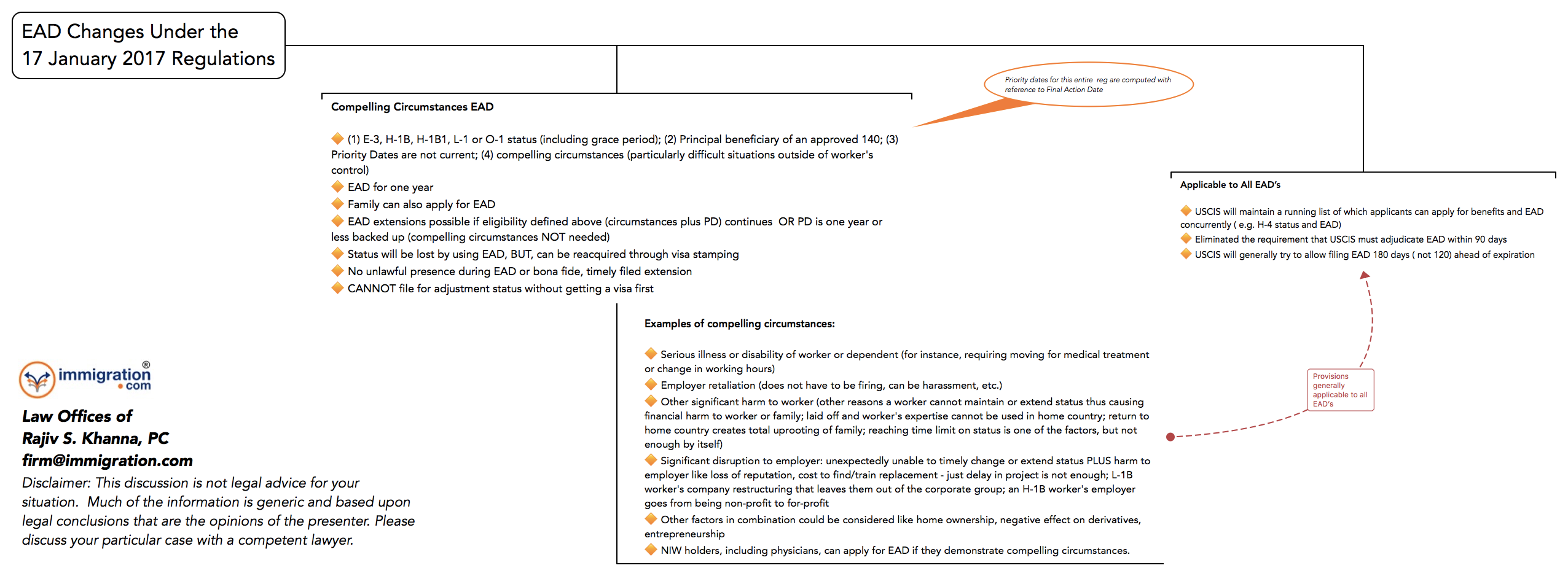
U.S. Citizenship and Immigration Services today released policy guidance on the eligibility criteria for initial and renewal applications for employment authorization documents (EADs) in compelling circumstances based on existing regulatory requirements at 8 CFR 204.5(p).
For an applicant to be eligible for an initial EAD based on compelling circumstances, they must meet the following eligibility requirements:
The Department has posted new Frequently Asked Questions (FAQs) for the H-1B, H-1B1 and E-3 Programs.
To view FAQ please check the attachment.