
Search
Changes to Direct Filing Addresses for Certain H-1B Form I-129 Petitions
On Sept. 1, we will change the direct filing addresses for certain petitioners filing Form I-129, Petition for a Nonimmigrant Worker. The changes apply to the following cap-exempt H-1B petitions:
SEVP Announces the SEVP Portal
On March 23, 2018, the Student and Exchange Visitor Program (SEVP) will launch the SEVP Portal for F-1 students participating in post-completion optional practical training (OPT) and M-1 students participating in practical training.
The portal will allow these F-1 and M-1 students to report personal and employer information directly to SEVP. Through the portal, these students will be able to:
Automatic Termination of Optional Practical Training for F-1 Students If They Transfer to a Different School or Begin Study at Another Educational Level
USCIS reminds F-1 students on Optional Practical Training (OPT) that transferring to another school or beginning study at another educational level (for example, beginning a master’s program after completing a bachelor’s degree) automatically terminates their OPT as well as their corresponding employment authorization document (EAD).
The Proposed I-140 EAD Rule - Continually Updated

This entry is now old law. The new law is at http://www.immigration.com/blogs/i-140-ead-regulations-effective-17-jan…
Note: Updated all of the regulations comments on 31 December 2015. I will keep adding, as needed.
DHS Enhances Opportunities for H-1B1, E-3, CW-1 Nonimmigrants and Certain EB-1 Immigrants, Final Rule Posted
The Department of Homeland Security (DHS) amended its regulations today to improve the programs serving the H-1B1, E-3 and CW-1 nonimmigrant classifications and the EB-1 immigrant classification, and remove unnecessary hurdles that place such workers at a disadvantage when compared to similarly situated workers in other visa classifications.
DHS Enhances Opportunities for H-1B1, E-3, CW-1 Nonimmigrants and Certain EB-1 Immigrants, Final Rule Posted
The Department of Homeland Security (DHS) amended its regulations today to improve the programs serving the H-1B1, E-3 and CW-1 nonimmigrant classifications and the EB-1 immigrant classification, and remove unnecessary hurdles that place such workers at a disadvantage when compared to similarly situated workers in other visa classifications.
Recording of Free Community Conference Call (Every Other Thursday), 11 February 2016
Immigration Law
Green Card
Discussion Topics, Thursday, 11 February 2016:
FAQ: Traveling on EAD, Advance Parole, H-4; Does changing jobs require restarting green card; Returning to H-1 after I-485 EAD; Birth certificates and affidavits of birth, non-availability certificate, secondary evidence; E-3 visa change of employers and filing green card; Options after 6 years of H-1 are completed; Extending B-2 visa and status for dependent parent; Effect of change in project on EB-1C (International Managers/Executives) green card.
Other: H-4 for autistic son over 21; H-1 amendment location has changed; Using B-1 B-2 visa after Advance Parole expire, I-485 is abandoned; H-1 reuse and quota; I-140 priority date transfer and returning to old employer; H-1 quota if no visa was stamped; I-485 RFE; Correcting errors on Form I-130; Starting green card with new employer, porting (transfer of) priority date; AC21 changing jobs while RFE is pending; Denial of Form I-751, conditional permanent residence (green card); Resetting the clock on H-1B and L-1B; H-4 EAD issues; Applying for change of status from H-3 to F-1.
SEVP Unveils Online STEM OPT Hub
On Friday, the U.S. Department of Homeland Security published amended regulations on optional practical training (OPT) for certain international students with science, technology, engineering and mathematics (STEM) degrees from U.S. institutions of higher education. The amended regulations will go into effect May 10. Under the new regulations, certain students can apply to have a STEM OPT extension of 24 months. The new regulations also enhance federal oversight of the training program.
US Work and Immigration Options for Foreign Professionals
US Work and Immigration Options for Foreign Professionals
A discussion with two members of our community
E-3 Visa
Overview
The E-3 visa allows for the admission of an alien who is a national of the Commonwealth of Australia and who is entering the U.S. to perform services in a “specialty occupation.” The E-3 visa has many advantages over the other types of working visas, including the ability for spouses of E-3 recipients to apply for work authorization.
Nonimmigrant Visas
Outline of Compelling Circumstances EAD Regs
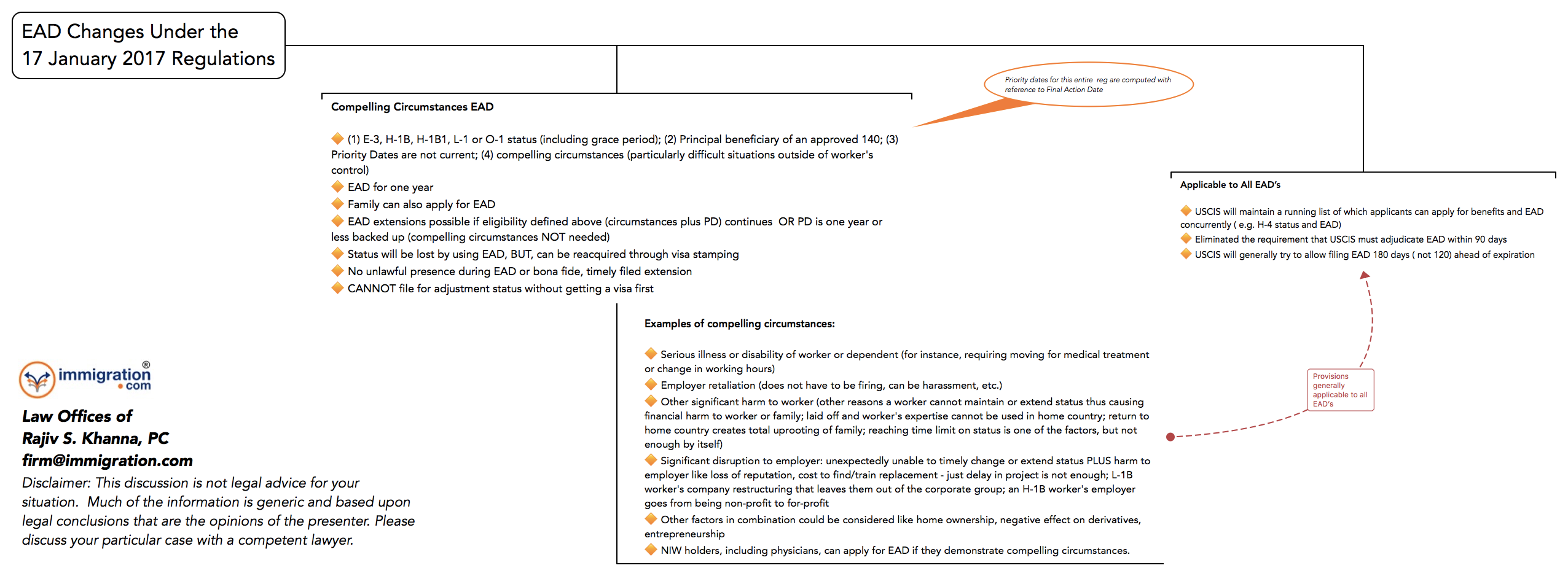
Green Card
Certain Students Applying for English Language Study and 24-month STEM OPT Extension Programs Affected by the ACICS Loss of Accreditation
On December 12, 2016, the U.S. Department of Education (ED) announced that it no longer recognizes the Accrediting Council for Independent Colleges and Schools (ACICS) as an accrediting agency. This determination immediately affects two immigration-related programs:
Success in responding to a Request for Evidence after filing an E-3 Petition
We assisted in responding to an RFE questioning the employer’s educational requirements for an E-3 (Specialty Occupation Workers from Australia) Petition filed for a software developer position. USCIS sought clarification as to how the position could be a specialty occupation where the employer required a minimum of a bachelor’s degree in business, information systems, computer science or equivalent with related experience.
Nonimmigrant Visas
Agency
Immigration Law
Success in responding to a Request for Evidence after filing an E-3 Petition
We assisted in responding to an RFE questioning the employer’s educational requirements for an E-3 (Specialty Occupation Workers from Australia) Petition filed for a software developer position. USCIS sought clarification as to how the position could be a specialty occupation where the employer required a minimum of a bachelor’s degree in business, information systems, computer science or equivalent with related experience.
USCIS Updates Guidance on Employment Authorization for E and L Nonimmigrant Spouses
Release Date
03/18/2022
U.S. Citizenship and Immigration Services is updating guidance in the USCIS Policy Manual to address the documentation that certain E and L nonimmigrant spouses may use as evidence of employment authorization based on their nonimmigrant status.
Successful response to a Form I-485 RFE related to events that occurred over a decade ago
We responded to a Form I-485 Request for Evidence to prove that approximately a decade ago the permanent residency applicant had, in fact, attended two U.S. universities as he had claimed in previously approved petitions. Both universities had been certified by ICE under its Student and Exchange Visitor Program (SEVP) during the applicant’s attendance.
Nonimmigrant Visas
Green Card
Successful response to a Form I-485 RFE for misrepresentation
We responded to a Form I-485 Request for Evidence to prove that approximately a decade ago the permanent residency applicant had, in fact, attended two U.S. universities as he had claimed in previously approved petitions. Both universities had been certified by ICE under its Student and Exchange Visitor Program (SEVP) during the applicant’s attendance.
Nonimmigrant Visas
Green Card
Immigration Law
Immigration.com
ACICS Loss of Recognition May Affect Certain Students Applying for English Language Study and 24-month STEM OPT Extension Programs, H-1B, and I-140 Applicants
Release Date
11/01/2022
On Aug. 19, the U.S. Department of Education (ED) announced that it no longer recognizes the Accrediting Council for Independent Colleges and Schools (ACICS) as an accrediting agency. This determination immediately affects two immigration-related student programs:
DOL Updates FAQ on Prevailing Wages for H-1B, H-1B1, and E-3 Programs
The Office of Foreign Labor Certification has posted new and updated Labor Condition Application (LCA/ ETA Form 9035/9035E) Frequently Asked Questions (FAQs) for the H-1B, H-1B1 and E-3 programs.
For the new FAQs click here.
I-140 EAD Regulations Effective 17 January 2017

2 December 2016
Radio Show Discussing Overview of the new I-140 EAD Regulations
2 December 2016
Discussing I-140 EAD FAQ in community conference call
H-3 Visa Trainees
General Information
An H-3 classification applies to an alien who is coming temporarily to the United States:
(1) As a trainee, other than to receive graduate medical education or training, or training provided primarily at or by an academic or vocational institution, or
(2) As a participant in a special education exchange visitor program which provides for practical training and experience in the education of children with physical, mental, or emotional disabilities.
Nonimmigrant Visas
SEVP modifies temporary exemptions for nonimmigrant students taking online courses during fall 2020 semester
WASHINGTON – The Student and Exchange Visitor Program (SEVP) announced modifications Monday to temporary exemptions for nonimmigrant students taking online classes due to the pandemic for the fall 2020 semester. The U.S. Department of Homeland Security plans to publish the procedures and responsibilities in the Federal Register as a Temporary Final Rule.
Temporary exemptions for the fall 2020 semester include: