
Search
Changes to Direct Filing Addresses for Certain H-1B Form I-129 Petitions
On Sept. 1, we will change the direct filing addresses for certain petitioners filing Form I-129, Petition for a Nonimmigrant Worker. The changes apply to the following cap-exempt H-1B petitions:
USCIS Changing Policy on Accrued Unlawful Presence by Nonimmigrant Students and Exchange Visitors
WASHINGTON—U.S. Citizenship and Immigration Services (USCIS) today posted a policy memorandum (PDF, 179 KB)changing how the agency will calculate unlawful presence for students and exchange visitors in F, J, and M nonimmigrant status, including F-2, J-2, or M-2 dependents, who fail to maintain their status in the United States.
The Proposed I-140 EAD Rule - Continually Updated

This entry is now old law. The new law is at http://www.immigration.com/blogs/i-140-ead-regulations-effective-17-jan…
Note: Updated all of the regulations comments on 31 December 2015. I will keep adding, as needed.
DHS Enhances Opportunities for H-1B1, E-3, CW-1 Nonimmigrants and Certain EB-1 Immigrants, Final Rule Posted
The Department of Homeland Security (DHS) amended its regulations today to improve the programs serving the H-1B1, E-3 and CW-1 nonimmigrant classifications and the EB-1 immigrant classification, and remove unnecessary hurdles that place such workers at a disadvantage when compared to similarly situated workers in other visa classifications.
DHS Enhances Opportunities for H-1B1, E-3, CW-1 Nonimmigrants and Certain EB-1 Immigrants, Final Rule Posted
The Department of Homeland Security (DHS) amended its regulations today to improve the programs serving the H-1B1, E-3 and CW-1 nonimmigrant classifications and the EB-1 immigrant classification, and remove unnecessary hurdles that place such workers at a disadvantage when compared to similarly situated workers in other visa classifications.
USCIS Will Accept H-1B Petitions for Fiscal Year 2017 Beginning April 1, 2016
On April 1, 2016, U.S. Citizenship and Immigration Services (USCIS) will begin accepting H-1B petitions subject to the fiscal year (FY) 2017 cap. U.S. businesses use the H-1B program to employ foreign workers in occupations that require highly specialized knowledge in fields such as science, engineering and computer programming.
The congressionally mandated cap on H-1B visas for FY 2017 is 65,000. The first 20,000 H-1B petitions filed for individuals with a U.S. master’s degree or higher are exempt from the 65,000 cap.
US Work and Immigration Options for Foreign Professionals
US Work and Immigration Options for Foreign Professionals
A discussion with two members of our community
USCIS Reaches FY 2017 H-1B Cap
U.S. Citizenship and Immigration Services (USCIS) has reached the congressionally mandated H-1B cap for fiscal year (FY) 2017. USCIS has also received more than the limit of 20,000 H-1B petitions filed under the U.S. advanced degree exemption.
USCIS will use a computer-generated process, also known as the lottery, to randomly select the petitions needed to meet the caps of 65,000 visas for the general category and 20,000 for the advanced degree exemption.
USCIS Completes the H-1B Cap Random Selection Process for FY 2017
U.S. Citizenship and Immigration Services (USCIS) announced on April 7, 2016, that it has received enough H-1B petitions to reach the statutory cap of 65,000 visas for fiscal year (FY) 2017. USCIS has also received more than the limit of 20,000 H-1B petitions filed under the advanced degree exemption, also known as the master’s cap.
Fiscal Year 2017 H-1B Cap Premium Processing to Begin May 12
On May 12, 2016, U.S. Citizenship and Immigration Services (USCIS) will begin premium processing for cap-subject H-1B petitions requesting premium processing, including petitions seeking an exemption for individuals with a U.S. master’s degree or higher.
E-3 Visa
Overview
The E-3 visa allows for the admission of an alien who is a national of the Commonwealth of Australia and who is entering the U.S. to perform services in a “specialty occupation.” The E-3 visa has many advantages over the other types of working visas, including the ability for spouses of E-3 recipients to apply for work authorization.
Nonimmigrant Visas
USCIS to Resume H-1B Premium Processing for Physicians under the Conrad 30 Waiver Program
U.S. Citizenship and Immigration Services announced today that starting Monday, June 26, the agency will resume premium processing for all H-1B petitions filed for medical doctors under the Conrad 30 Waiver program, as well as interested government agency waivers.
USCIS to Resume H-1B Premium Processing for Certain Cap-Exempt Petitions
U.S. Citizenship and Immigration Services (USCIS) will resume premium processing for certain cap-exempt H-1B petitions effective immediately. The H-1B visa has an annual cap of 65,000 visas each fiscal year. Additionally, there is an annual “master’s cap” of 20,000 petitions filed for beneficiaries with a U.S. master’s degree or higher.
Premium processing will resume for petitions that may be exempt from the cap if the H-1B petitioner is:
* An institution of higher education;
* A nonprofit related to or affiliated with an institution of higher education; or
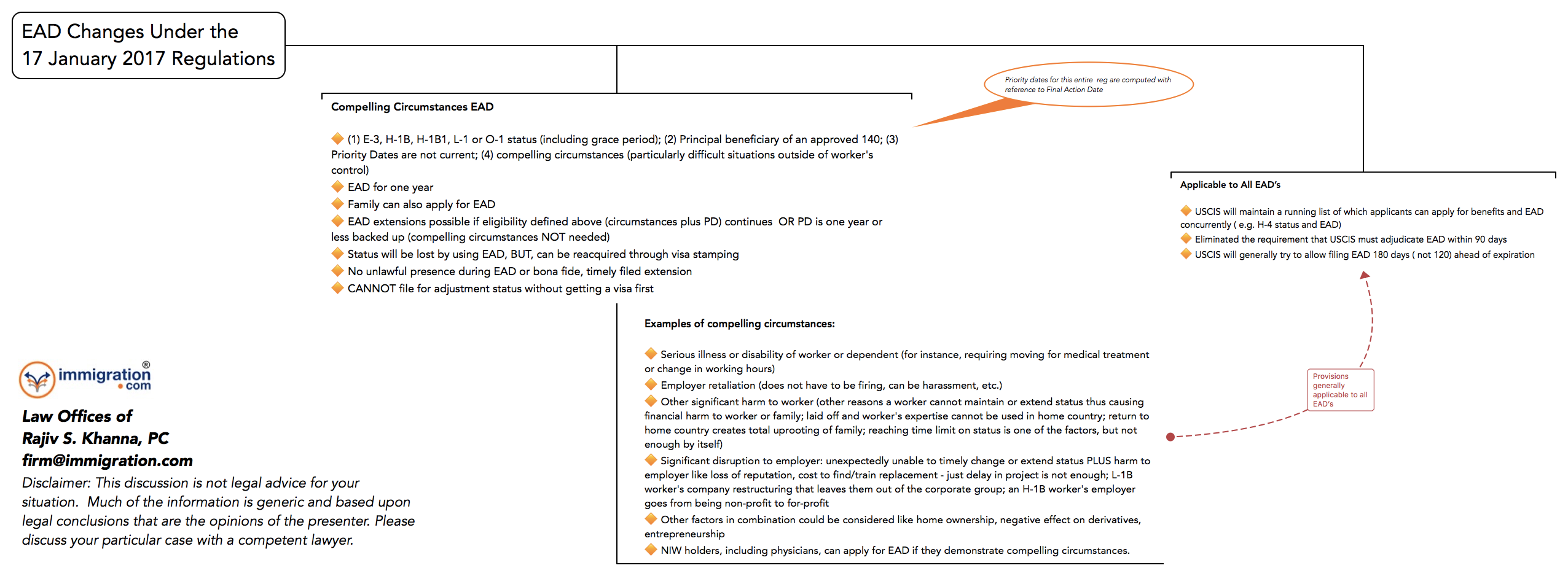
Outline of Compelling Circumstances EAD Regs
Green Card
Success in responding to a Request for Evidence after filing an E-3 Petition
We assisted in responding to an RFE questioning the employer’s educational requirements for an E-3 (Specialty Occupation Workers from Australia) Petition filed for a software developer position. USCIS sought clarification as to how the position could be a specialty occupation where the employer required a minimum of a bachelor’s degree in business, information systems, computer science or equivalent with related experience.
Nonimmigrant Visas
Agency
Immigration Law
Success in responding to a Request for Evidence after filing an E-3 Petition
We assisted in responding to an RFE questioning the employer’s educational requirements for an E-3 (Specialty Occupation Workers from Australia) Petition filed for a software developer position. USCIS sought clarification as to how the position could be a specialty occupation where the employer required a minimum of a bachelor’s degree in business, information systems, computer science or equivalent with related experience.
USCIS Updates Guidance on Employment Authorization for E and L Nonimmigrant Spouses
Release Date
03/18/2022
U.S. Citizenship and Immigration Services is updating guidance in the USCIS Policy Manual to address the documentation that certain E and L nonimmigrant spouses may use as evidence of employment authorization based on their nonimmigrant status.
DOL Updates FAQ on Prevailing Wages for H-1B, H-1B1, and E-3 Programs
The Office of Foreign Labor Certification has posted new and updated Labor Condition Application (LCA/ ETA Form 9035/9035E) Frequently Asked Questions (FAQs) for the H-1B, H-1B1 and E-3 programs.
For the new FAQs click here.
Recording of Free Community Conference Call (Every Other Thursday), 28 July 2016
Immigration.com
Agency
Citizenship and Naturalization
Discussion Topics, Thursday, 28 July 2016:
FAQ: Criminal record, affect on naturalization, other risks; Criteria for EB-1C, international managers and executives, impact of receiving benefits; Tourist/Visitors/B-2 visa denial 214(b); How long is an I-140 approval valid; Legalizing status; Change of work location after filing for naturalization N-400 - 90-day rule for domicile; Gap required on a B visa revisit.
Other: Student (M-1) Visa stamping, changing to F-1; N-600; Conflicting I-94 on H-1 extension and amendment; 221(g) on H-1 visa; Priority date transfer after I-140; J-2 EAD processing; Protecting H-1 holder's share in company, green card processing; H-1B transfer salary and reporting company; H-1B changing employers, etc.; spouse of green card holder issues; When to file I-140/AOS after PERM approval; Correcting records with CBP; Overstay on B visa alleged; etc.
Recording of Free Community Conference Call (Every Other Thursday), 1 October 2015
Immigration.com
Green Card
We discussed these (and other) issues of US immigration:
FAQ: Can a J-2 holder get a HRR 212(e) waiver without J-1?
Other: Retaining green card while in Canada; Starting my company, violation of status; I-140 revocation; Unused H-1B for quota exemption; H1B to H4 COS without latest Paystubs; EAD renewal separated from spouse; H-4 EAD approved in error; Effect of salary reduction; H-1 transfer, OPT travel; Visa Waiver apply for AOS; Retaining priority date; Visa stamping for H-1B amendment; Arrest without conviction; Reentry permit, etc.
Recording of Free Community Conference Call (Every Other Thursday), 15 October 2015
Immigration.com
Nonimmigrant Visas
Topics for Discussion:
FAQ: J-2 or J-1 with 212(e) HRR converting to F-1 student; FAQ: For PERM is formal certificate required or completion of degree is enough; Correcting dates on I-94; Travel while H-1 extension pending – change in I-94#; Changing employers - what immigration documents should I keep; FAQ: Maternity leave on H-1, FMLA and status.
Other: Multiple I-140 approvals; I-140 denial; Cap-gap extension; Effect of change in citizenship on H-1; PERM/AC21 and multiple I-485 filing; Family-based green card change in category; Child turning 21 – CSPA and derivative non-immigrant status loss; L-1A visa and EB-1C filing; Filing I-485 for spouse; PERM more than 50% different job; Cross chargeability; I-130 fraud by spouse; Maternity leave on H-1; AOS filing; F-2 COS; H-1quota, etc.
I-140 EAD Regulations Effective 17 January 2017

2 December 2016
Radio Show Discussing Overview of the new I-140 EAD Regulations
2 December 2016
Discussing I-140 EAD FAQ in community conference call
USCIS Will Accept H-1B Petitions for Fiscal Year 2018 Beginning April 3
U.S. Citizenship and Immigration Services will begin accepting H-1B petitions subject to the fiscal year 2018 cap on April 3, 2017. All cap-subject H-1B petitions filed before April 3, 2017, for the FY 2018 cap will be rejected.