Guestbook Entry for Prateek Rishi, United States
Name
Prateek Rishi
Country
United States
State
NY

USCIS generally process cases in the order they receive them. The link below provides you an estimate of how much time the office handling your case currently takes to process your type of application, petition, or request.

We recently filed an application for an EAD based on compelling circumstances for a client with a major medical concern. The applicant was on an H-1B status. We provided a petition to USCIS outlining the applicant’s medical history and the ongoing treatment that showed the progression of his illness, which limited his ability to perform his job duties. He was initially placed on short-term disability but as the condition progressed, it was necessary for applicant to be placed on long-term disability.
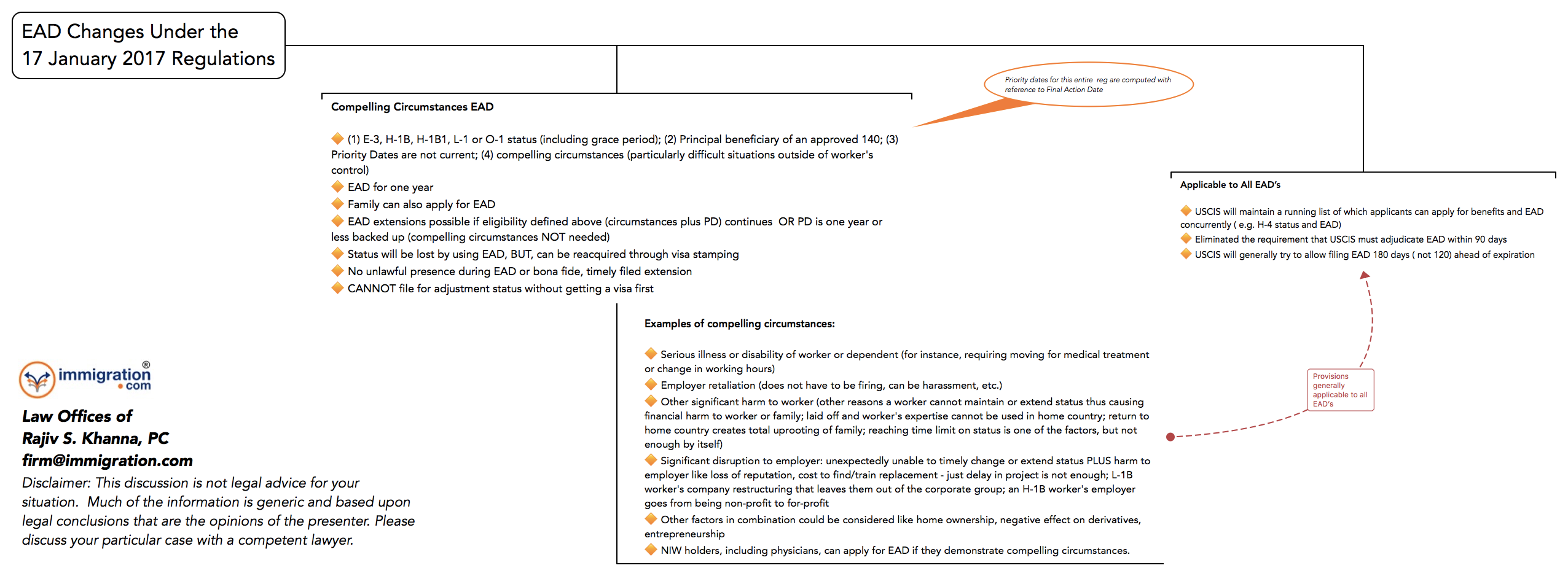
The regulations enacted by the USCIS on 17 January 2017 have created a new class of employment authorization - "Compelling Circumstances EAD." This is available to those people whose I-140 is approved and priority dates are not yet current.
This is a compelling circumstances EAD approved in appx. 100 days in July 2017 based upon health grounds.See: http://www.immigration.com/sample-cases/%5Bcompelling-circumstances-ead…
As of June 29, 2017, we began implementing the Executive Order at our embassies and consulates abroad in compliance with the Supreme Court’s decision and in accordance with the Presidential Memorandum issued on June 14, 2017. Our implementation is in full compliance with the Supreme Court’s decision.
USCIS recently updated the following form(s):
Update to Form I-821, Application for Temporary Protected Status08/04/2017 12:00 AM EDTNew edition dated 12/23/16. A new edition of this form is coming soon. In the meantime, you may file using the 12/23/16 or 02/20/14 editions. For more information, please visit Forms Updates page.
PERM Processing Times (as of 6/30/2017)
Number 9
Volume X
Washington, D.C
A. STATUTORY NUMBERS
This bulletin summarizes the availability of immigrant numbers during September for: “Final Action Dates” and “Dates for Filing Applications,” indicating when immigrant visa applicants should be notified to assemble and submit required documentation to the National Visa Center.
HOUSTON — U.S. Customs and Border Protection announced today the deployment of facial recognition biometric exit technology to William P. Hobby International Airport (HOU) in Houston for select flights from HOU. The deployment builds upon a June 2016 pilot at Hartsfield-Jackson Atlanta International Airport using facial recognition.
Discussion topics:
EAD Renewals, prevailing wages for Illinois, H-1B transfer, F2A category Green Card, Rules changed on LCA,
Point system - how it will affect those who are already waiting for Green Card.
Are you seeking to adjust your status and become a U.S. permanent resident under a family-sponsored or employment-based preference immigrant visa? If you have not yet had a relative or employer file an immigrant visa petition on your behalf, please learn more about the Adjustment of Status Filing Process.
USCIS recently updated the following form(s):
Update to Form N-4, Monthly Report Naturalization Papers
08/14/2017 12:00 AM EDT
New edition dated 08/01/17. You may also file using these previous editions: 10/26/15, 01/22/13 and 11/09/09.
U.S. Citizenship and Immigration Services (USCIS) is issuing policy guidance in the USCIS Policy Manual to address the general policies and procedures applicable to the adjudication of waivers of inadmissibility.
Please check this link for more information "Waiver Policies and Procedures".
Finally after a very long wait, we had our interviews yesterday at the USCIS Seattle office. The interview and tests went well and the officer let us know that she was approving our citizenship cases and asked whether we would like to attend our oath ceremony the same day. We attended the oath ceremony at 1:00 PM yesterday and received our citizenship certificates. So to answer your question, yes the Seattle office has same day oath ceremonies all 4 week days except Fridays (I asked).
USCIS recently updated the following form(s):
WASHINGTON – U.S. Citizenship and Immigration Services (USCIS) will begin expanding in-person interviews for certain immigration benefit applicants whose benefit, if granted, would allow them to permanently reside in the United States. This change complies with Executive Order 13780, “Protecting the Nation From Foreign Terrorist Entry Into the United States,” and is part of the agency’s comprehensive strategy to further improve the detection and prevention of fraud and further enhance the integrity of the immigration system.
Visas prohibited for most construction workers and employers must pay higher education fee for FY 2017 and future fiscal years
The following Immigration Policy Memorandum is now available:
FAQ: Fastest method of getting spouse of a green card into the USA and reducing wait
FAQ: Is new H-1B visa stamping needed if you change employers?
FAQ: H-1B visa stamping in Canada or Mexico; importance of I-94
FAQ: What are the options of an H-1B visa is denied and petition sent for revocation?
USCIS offers immigration services that may help people affected by unforeseen circumstances, including disasters such as Hurricane Harvey.
The following measures may be available on a case-by-case basis upon request:
I had my interview today morning (2/6/2012) and I got "Congratulations, your application is recommended for approval." letter at the end .
The lady was nice and friendly. Here is the flow of events:
She asked me to stand and swear that I will tell the truth.
Right after I sworn in, she went over application and reviewed pretty much entire application. Few questions along the way but nothing major or didn't ask for any documents/proof. Also no corrections were needed so nothing major on that part except review and check marks.
Transcript: Employment Authorization (EAD) for H-4 Holders Proposed
I was asked to comment about the proposed rule that would allow certain H-4 holders to get employment authorization. What I have opened on the screen is the current status as of December 16, 2012. This rule is currently being reviewed by the Office of Management and Budget’s sub-office OIRA, which is the Office of Information and Regulatory Affairs. The idea is that under Executive Order 12866--I am not giving you too many details just trying to keep it to the minimal--regulations before they move forward beyond a certain point, they need to be reviewed by the White House. It is not something that President Obama does himself, of course--you all know that--it is people who are experts in federal regulation within the White House under the office of OMB—OIRA. They are the people who are charged with the responsibility of making sure the regulations are sound in terms of policy, in terms of time, cost, compliance, etc.
I want to point out a few things. If you look at this, it says current action is NPRM (Notice of Proposal Rule Making). That means once this is okayed by the OMB, a Notice of Proposed Rule Making will be put out in the Federal Register. If you look at this right here, it doesn’t have a FR (Federal Register) citation right now, because it has not yet been published. So once it is approved and NPRM (Notice of Proposed Rule Making) would be published in the Federal Register, which basically means the government will formally notify everybody that we intend to make a rule and if you have any comments about that, let us have them. There is a lot of variation in regulations and how they are made. Let me get to that in a second.
But I want to point out this abstract to you. What does it say? It says we are going to allow those H-4 holders to get work authorizations whose husbands have crossed over six years of their H-1 and now they are in extended H-1 beyond six years, either three-year period or one-year period. These two periods are referred to as Section 104C and 106A. These two periods depend upon when the labor certification was filed. If the labor certification was filed a year ago, anyone who is on H-1 six-year term can get their H-1 extended on a year-to-year basis. So that year-to-year extension is tied in with your labor certification date. So, first anniversary of the labor certification allows one-year extension.
The second method of getting H-1 extension, which is the three-year method, is if your I-140 is approved regardless of when your labor certification was filed. So, if you are in any of these two categories and exceeded your H-1 and you’ve now extended your H-1 beyond six years, your spouse would be then entitled to get work authorization. I think it is very fair and, as the abstract notes, this is to encourage professionals with high-demand skills to remain in the country. Think about it. Somebody who is on H-1 has been here for six years--they have done everything by the book, they have done it legally--there is no reason for them to have to wait any longer for their spouses to work. It is just highly unfair, and we have been pointing this out--not only us but the entire set of stakeholders, the community, lawyers, agencies that are involved, non-profits that are involved in the process. It’s been pointed out to the government that people who have been waiting for their legal immigration for years--I mean typically what is the life-span—let’s just take for example, India or China. You enter USA typically on a student visa. You do your Master’s for a couple of years or your Ph.D. and your Ph.D. sometimes for five or six years. Then you get into H-1 six years after that. You will get this benefit. So that’s like 15 years for many of you, but definitely no less than six years.
If, on the other hand, government were to legalize folks who are here illegally. I am not saying they should not be legalized; I am saying that we’ve got to have some equity here and this is one step--very, very small step--towards equity. I personally feel like in L-2, H-1 visa holders, their spouses should be allowed to start working on the day they enter USA. Why is this distinction made between L-2 holders and H-4 holders? L-2 holders are allowed to work day one when they enter USA. There is no philosophical or policy difference between L-2 and H-4. In any case, we will take what we can get for the time being. At least this is a step in the right direction.
Now what happens after this process? Well, you know, some of my colleagues are predicting it could be as little less, as you know, three months or six months. I don’t think it is that simple, because remember typically what happens is first a notice of the rulemaking is provided or the rule itself can be provided as a proposed rule and then public is invited to comment for 30 to 60 days. Then the government goes back and analyzes those comments. This whole process can take a while. Then they can issue another revised version asking for more comments. Sometimes the comment period can be extended to 180 days. Then, on top of that, and during the Congressional review time, which is while the regulations are still not implemented, they are finalized. Congress can come back and overrule the regulations. It’s difficult for them to do that at this point of time, but you know all these things are still uncertain so by no means can we say that this is certain to be implemented and when it is certain to be implemented. But it appears that for the first time in the last four or five years, some formal acknowledgment has been made by the Obama Administration and some acknowledgment has been made that there is a set of legal professional workers in the United States who have been much ignored.
Feel free to send us emails through the Contact Us form on our website. Send us an email if something is unclear. I will be happy to address as much of it as I can.
I also wanted to add one thing as an afterthought. You do know that, of course, once you file your I-485 Adjustment of Status, your spouse on H-4 is entitled to their EAD. This is an addition to that right. So even if you are--obviously I think it is quite clear, but just in case it isn’t--even if you are not in the I-485 step of the process, you can still get employment authorization for your H-4 spouse if this rule were to be implemented. I just thought I will add that. Thanks.
I have received a couple of questions from a client and a member of the community.
First--What is the exact process?
Well, the process is quite variable. From here on, a lot of things can be done differently. In fact, the government can publish a rule without giving a notice and comment period, if they want, because if the rule is urgent enough or they want it to be implemented--or it is not necessary or useful to have notice and comment--it can be implemented without notice and comment. It is unlikely. So the process is actually quite amorphous. It can have many variations. It is very difficult to pinpoint exactly what is going to happen. But a lifetime once it moves out of the OMB is typically about 180 days or six months or so. Another great variable is how long does the agency think the notice and comment period should be kept open. Like I said, sometimes, it can be as much as 180 days.
An interesting question was asked--Does this have to go to the Senate or House for approval?
The answer is no. This is not a law--this is a regulation. Regulations are dealt with entirely on the side of the administration by the government. It does not go to the legislature. The only way the legislature can overrule it is if both the sides—the Senate as well as House of Representatives--passes a resolution overruling the regulation, and the President signs it. If the President doesn’t sign it, then I guess what they have to do is override his veto, which is very, very difficult--if I remember correctly with a two-third majority of the two houses--so that is very unlikely to happen. I guess that should also clarify things for you folks a little bit more. Keep the questions coming. I will answer them as quickly as I can.