PERM FAQ 2 from DOL website
For additional FAQs on PERM and Backlog, please see the links below:

For additional FAQs on PERM and Backlog, please see the links below:
Stub page for menu item - please reuse for real content
Stub - regugee and politcal asylum, please reuse for real content
Any lawful permanent resident (LPR) or a conditional resident (CR) must present an admission document like special immigrant visa (obtained at consulate abroad), green card or reentry permit upon entry to the U.S. after their temporary trip abroad. In the absence of such document he/she is considered inadmissible. If the LPR or CR seeks admission to the U.S. after more than one year since her departure from USA, the green card may not be sufficient to allow them back into the United States.

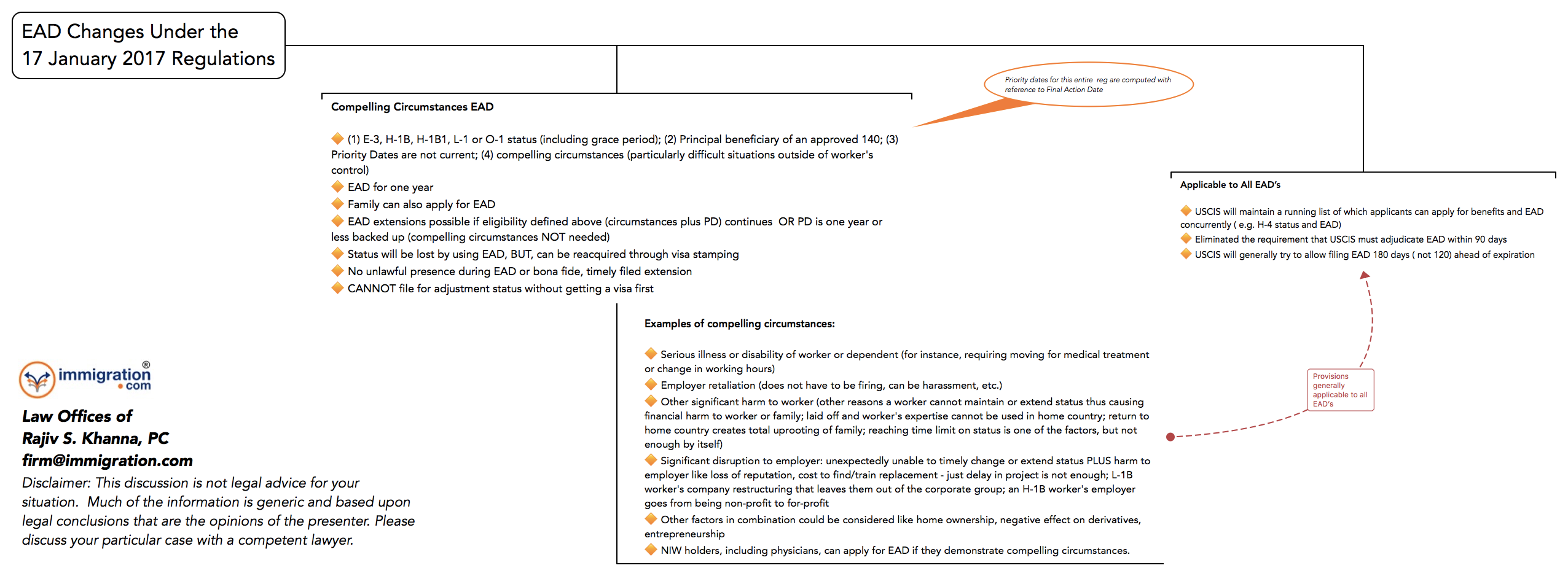
This is a compelling circumstances EAD approved in appx. 100 days in July 2017 based upon health grounds.See: http://www.immigration.com/sample-cases/%5Bcompelling-circumstances-ead…
To qualify as an EB-4 special immigrant religious worker, you must be a member of a religious denomination that has a non-profit religious organization in the United States. You must have been a member of this religious denomination for at minimum two years before applying for admission to the United States. Furthermore, you must be entering the United States to work:
As a minister or priest of the religious denomination;
U.S. citizens (USC) and Lawful Permanent Residents (LPRs) may file immigrant visa petitions with the U.S. Citizenship and Immigration Services (USCIS) on behalf of a spouse or child, so that these family members may immigrate to or remain in the United States. Sadly, certain cases exist where U.S. citizens and LPRs misuse their control of this process to abuse their family members. Consequently, most battered immigrants are fearful to report the abuse to the police or other authorities out of fear of losing their immigration benefits.
Editor's Note: We have highlighted certain areas of the executive order. A fully formatted PDF copy is attached above ↑.
0
0
1
1031
5877
Law Offices of Rajiv S. Khanna, PC
48
13
6895
14.0
Normal
0
false
false
false
EN-US
JA
X-NONE
This page will be continually updated as events develop
gtrthyty
sdasd
Topics covered include all aspects of legal issues confronting F-1 students in the USA.
Under the various employment based categories, Category I based permanent residency is the most difficult to obtain. Initially, the foreign national must determine if he/she is eligible for lawful permanent residency according to the USCIS guidelines.
An applicant filing an EB1 alien of extraordinary ability application may self-petition, but an applicant filing under outstanding researcher and/or professor and multinational manager must have a sponsoring employer.
The following persons fall under this category:
https://www.immigration.com/blogs/new-standards-national-interest-waiver-dhanasar-case
EB-3 Classification is appropriate for:
Professionals with a baccalaureate degree (or foreign equivalent degree but not necessarily any experience);
Skilled Workers with at minimum two years of experience (there is no degree requirement); and
Unskilled Workers who have less than two years of training or experience.
One of the ways a foreign national (alien) can become a permanent resident is through a permanent employment opportunity in the United States. There are five employment-based preference categories.
Most Green Cards are obtained through employment, investment, a family member’s petition, the Diversity Visa program, and a refugee/political asylum application. However, there are other ways to get a Green Card. These Green Cards are limited to individuals meeting particular qualifications and/or applying during certain time frames.
Individuals in the following categories can apply for Green Cards: