Guestbook Entry for Johnson Edwin Dodla , United States
Name
Johnson Edwin Dodla
Country
United States
State
PA

Discussion Topics, Thursday 21 June 2018:
FAQ: Changing jobs after I 140 approval || Can a green card be filed for me if I am on H4 or L2 or F1 – – any status other than H-1B or L-1A? || Can an employee withdraw an H-1B petition? || How to add forgotten information on to a naturalization application/N-400? Other: Changing jobs when an appeal to the Department of Labor (BALCA) is pending || Trading stocks while on H-1B or H4 status || Changing from H-1B to F1 status and back to H-1B again || How to extend my I 94 within the USA? || Obtaining EB2 with a three year degree || Procedure after a denied PERM is approved || Validity of I 140 after I 485 denial || Minimizing the future impact of an L-1A denial || Exemption from H-1B quota where visa is stamped but never joined the employer || WHD complaint against employer || Green card processing times || Receiving pension after surrender or loss of green card || Challenging wage levels determined by an employer || India EB-1 priority dates || Traffic violations in N400 || Checking status of PERM, etc.

This is the latest release from USCIS. I think they are misreading the fees requirement. The law seemed to require higher fees only for L-1 employee counts (see my highlighted comments below under 19 December 2015 entry). The current USCIS release counts both L-1 and H-1 employees even for H-1 filing fees. We will wait and see if this clarified
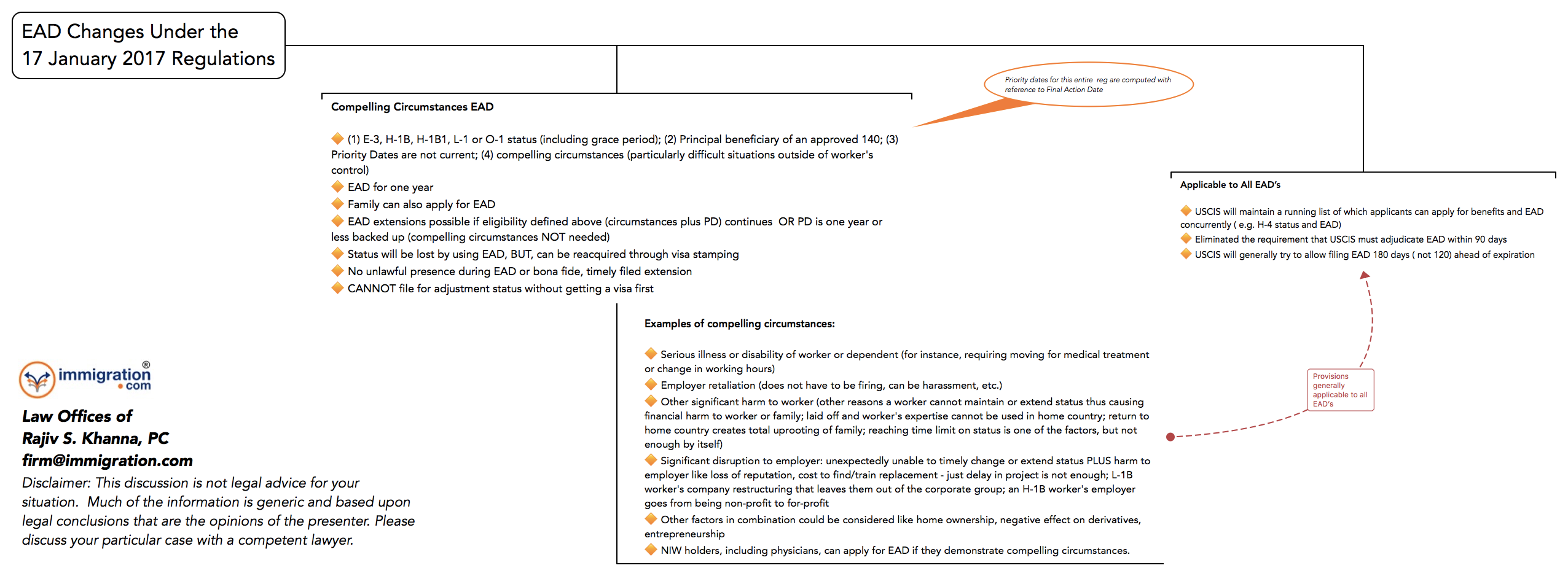
This entry is now old law. The new law is at http://www.immigration.com/blogs/i-140-ead-regulations-effective-17-jan…
Note: Updated all of the regulations comments on 31 December 2015. I will keep adding, as needed.
The Department of Homeland Security (DHS) amended its regulations today to improve the programs serving the H-1B1, E-3 and CW-1 nonimmigrant classifications and the EB-1 immigrant classification, and remove unnecessary hurdles that place such workers at a disadvantage when compared to similarly situated workers in other visa classifications.
The Department of Homeland Security (DHS) amended its regulations today to improve the programs serving the H-1B1, E-3 and CW-1 nonimmigrant classifications and the EB-1 immigrant classification, and remove unnecessary hurdles that place such workers at a disadvantage when compared to similarly situated workers in other visa classifications.
US Work and Immigration Options for Foreign Professionals
On February 12, 2018, the Texas Service Center (TSC) will begin processing certain Form I-129, Petition for a Nonimmigrant Worker petitions for L nonimmigrant classification, also known as L visas. The TSC will share this workload with the California Service Center to balance workloads and to provide flexibility as USCIS works towards improving processing times and efficiency. The Vermont Service Center will no longer process any new Form I‑129 petitions requesting L nonimmigrant classification.
The E-3 visa allows for the admission of an alien who is a national of the Commonwealth of Australia and who is entering the U.S. to perform services in a “specialty occupation.” The E-3 visa has many advantages over the other types of working visas, including the ability for spouses of E-3 recipients to apply for work authorization.
USCIS has changed the direct filing addresses for where to file certain forms for beneficiaries who will be working or training in Florida, Georgia, or North Carolina. The changes are as follows:
We assisted in responding to an RFE questioning the employer’s educational requirements for an E-3 (Specialty Occupation Workers from Australia) Petition filed for a software developer position. USCIS sought clarification as to how the position could be a specialty occupation where the employer required a minimum of a bachelor’s degree in business, information systems, computer science or equivalent with related experience.
We assisted in responding to an RFE questioning the employer’s educational requirements for an E-3 (Specialty Occupation Workers from Australia) Petition filed for a software developer position. USCIS sought clarification as to how the position could be a specialty occupation where the employer required a minimum of a bachelor’s degree in business, information systems, computer science or equivalent with related experience.
Release Date
03/18/2022
U.S. Citizenship and Immigration Services is updating guidance in the USCIS Policy Manual to address the documentation that certain E and L nonimmigrant spouses may use as evidence of employment authorization based on their nonimmigrant status.
We assisted our client, a nonprofit religious organization, in filing a nonimmigrant religious worker (R-1) petition for a new pastor. We received a Request for Evidence (RFE) in which USCIS questioned the petitioner's ability to compensate the beneficiary. We responded with additional documentation supporting Petitioner’s ability to pay and its nonprofit status, such as bank statements and a final determination letter granting tax-exempt status as issued by the IRS. The case was approved.
Discussion Topics, Thursday, Sept 16, 2021
FAQ: Consequences of extending parents’ B-1/B-2 (visitors/tourist) status more than once||Consequences of green card holders staying outside the USA for an extended time. Reentry permit protection ||Applied for EB-3 downgrade and change of employer after 180 days while I-140 is pending
I have reviewed the recent lawsuit settlement where the USCIS has agreed to consider H-4 holders to be eligible to continue working while their timely filed EAD extension is pending. Unfortunately, the settlement seems to state that the right to work is only co-extensive with your I-94 duration. Therefore, you do not have the right to continue working for 180 days; only till your I-94 expires. While it is better than nothing, the settlement is not everything that we would like to see.
Release Date
08/30/2022
U.S. Citizenship and Immigration Services (USCIS) is issuing policy guidance in the USCIS Policy Manual to reorganize and expand on existing guidance related to special immigrant and nonimmigrant religious workers.
This update reorganizes the special immigrant religious worker guidance for clarity and provides more comprehensive information about the special immigrant religious worker filing process, verification of evidence, and the site-inspection process.
For latest updates, watch this video with Rajiv from Dec 28, 2021.

Radio Show Discussing Overview of the new I-140 EAD Regulations
Discussing I-140 EAD FAQ in community conference call
On April 7, 2015, the U.S. Court of Appeals for the Third Circuit, in Shalom Pentecostal Church v. Acting Secretary DHS, 783 F.3d 156 (3d Cir. 2015), found the regulatory requirements that qualifying work experience gained in the United States must have been acquired in lawful status (herein “lawful status requirements”) in 8 CFR 204.5(m)(4) and (11) to be beyond the Department’s legal authority (ultra vires). The court found that the statute was clear and unambiguous and that the regulation was inconsistent with the statute.
USCIS has posted a new Web page on the H-1B and L-1 fee increase required by the Consolidated Appropriations Act, 2016 (Pub. L. 114-113). Pub. L. 114-113 requires certain petitioners to submit an additional fee of $4,000 for certain H-1B petitions and an additional $4,500 for certain L-1A and L-1B petitions.
We won a case for an applicant who primarily served as a function manager, but also managed a few professionals. We provided extensive details regarding the job duties of the beneficiary for both the foreign entity position as well as the proposed US position. We outlined the proposed duties in detail and assigned a percentage to each task indicating how much time was allotted to complete the task. We also provided the names, titles and job duty descriptions of staff members that would relieve the beneficiary of non-managerial tasks.
We won a case following a Request for Evidence that requested additional proof of the relationship between the entities, verification of employment abroad in a managerial role for one continuous year prior to entering the US, as well as additional details of the proposed managerial position in the U.S. Initially we submitted documentation to establish the relationship between the U.S.