
Search
USCIS Workload Transfer Updates
USCIS transferred some of the following cases from the Vermont Service Center to the Texas Service Center:
- Form I-539, Application to Extend/Change Nonimmigrant Status, for F, M, J, or B nonimmigrants
For more information, see Workload Transfer Updates page.
Workload Transfer Update
USCIS transferred some of the following cases from the Vermont Service Center to the Texas Service Center, Nebraska Service Center, California Service Center, and Potomac Service Center:
- Form I-539, Application to Extend/Change Nonimmigrant Status, for F, M, J, or B nonimmigrants
For more information, see Workload Transfer Updates page.
Jan 24, 2019, Recording of Free Community Conference Call (Every Other Thursday)
Immigration.com
Nonimmigrant Visas
Green Card
Discussion Topics, Thursday, 24 January 2019:
FAQ: Green Card portability for EB-1C international managers or executives||What is the advantage of EB2 over EB3 category?|| Difference between final action dates for employment-based preference cases b. Dates for filing of employment-based visa applications ||
Other: Consequences of moving locations for H-1B and green card cases ||Green card through marriage||H-1B approval beyond six years based upon I-140 approval of another employer||Defining same or similar job for AC 21 portability||Cross chargeability||Converting from EB-2 to EB-3 ||Doing business on H-1B ||Changing employers from nonprofit to for-profit ||Rejoining an old job after a denial of an H-1B transfer||Difference between AC 21 portability and 240 days regulation to continue working on H-1B ||When is a Supplement J required?
Successful J-1 waiver
New
Nonimmigrant Visas
USCIS Changing Policy on Accrued Unlawful Presence by Nonimmigrant Students and Exchange Visitors
WASHINGTON—U.S. Citizenship and Immigration Services (USCIS) today posted a policy memorandum (PDF, 179 KB)changing how the agency will calculate unlawful presence for students and exchange visitors in F, J, and M nonimmigrant status, including F-2, J-2, or M-2 dependents, who fail to maintain their status in the United States.
May 24, 2018, Recording of Free Community Conference Call (Every Other Thursday)
Immigration.com
Citizenship and Naturalization
Nonimmigrant Visas
Green Card
The Proposed I-140 EAD Rule - Continually Updated

This entry is now old law. The new law is at http://www.immigration.com/blogs/i-140-ead-regulations-effective-17-jan…
Note: Updated all of the regulations comments on 31 December 2015. I will keep adding, as needed.
DHS Enhances Opportunities for H-1B1, E-3, CW-1 Nonimmigrants and Certain EB-1 Immigrants, Final Rule Posted
The Department of Homeland Security (DHS) amended its regulations today to improve the programs serving the H-1B1, E-3 and CW-1 nonimmigrant classifications and the EB-1 immigrant classification, and remove unnecessary hurdles that place such workers at a disadvantage when compared to similarly situated workers in other visa classifications.
State Dept. Notice Regarding Implementation of Changes to the Visa Waiver Program
For Immediate Release
DHS Press Office
Contact: 202-282-8010
DHS Enhances Opportunities for H-1B1, E-3, CW-1 Nonimmigrants and Certain EB-1 Immigrants, Final Rule Posted
The Department of Homeland Security (DHS) amended its regulations today to improve the programs serving the H-1B1, E-3 and CW-1 nonimmigrant classifications and the EB-1 immigrant classification, and remove unnecessary hurdles that place such workers at a disadvantage when compared to similarly situated workers in other visa classifications.
US Work and Immigration Options for Foreign Professionals
US Work and Immigration Options for Foreign Professionals
A discussion with two members of our community
E-3 Visa
Overview
The E-3 visa allows for the admission of an alien who is a national of the Commonwealth of Australia and who is entering the U.S. to perform services in a “specialty occupation.” The E-3 visa has many advantages over the other types of working visas, including the ability for spouses of E-3 recipients to apply for work authorization.
Nonimmigrant Visas
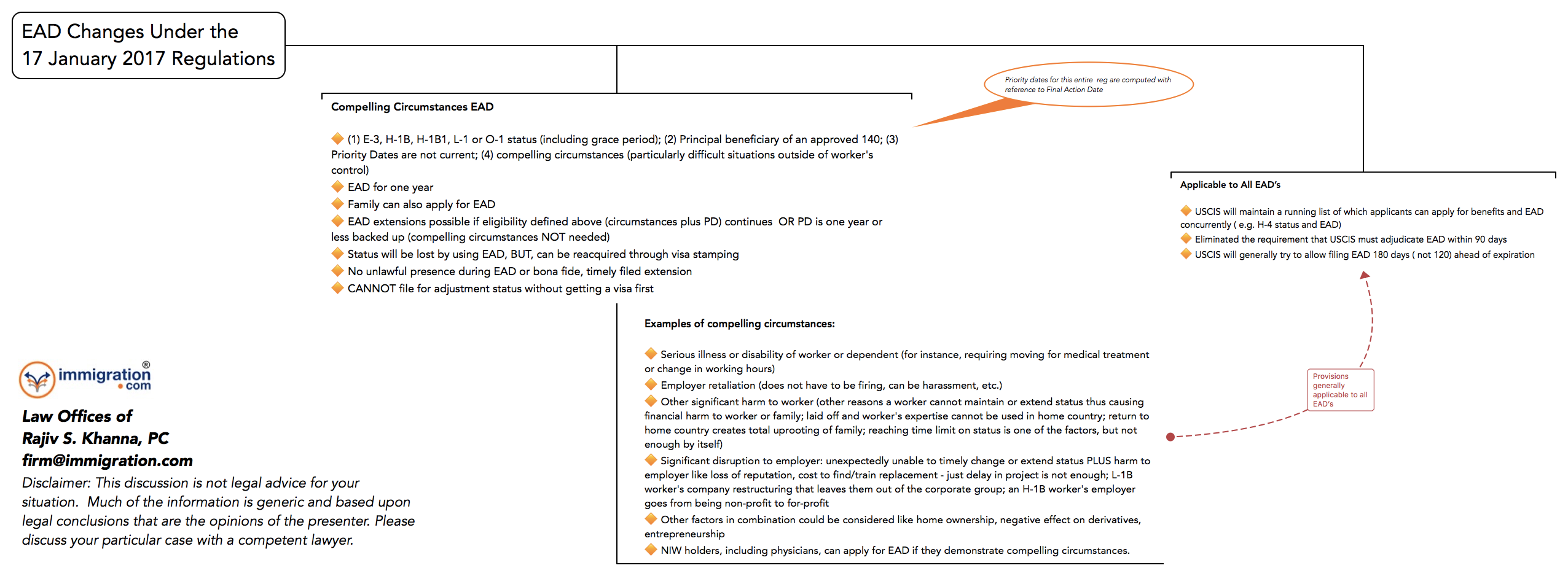
Outline of Compelling Circumstances EAD Regs
Green Card
Oct 3, 2019 Recording of Free Community Conference Call (Every Other Thursday)
Immigration.com
Citizenship and Naturalization
Nonimmigrant Visas
Green Card
Discussion Topics, Thursday, October 3, 2019
FAQ: When should we file Supplement J for AC21 || Changing employers after 180 days of I-140 approval || Filing an I-485 for a junior position when already promoted || Expediting H-4 EAD || Is there a correlation between processing times and priority dates? || Traveling while H-4 EAD extension is pending.
OTHER: 60 days grace period between H-1B petitions || Options for alleged OPT/CPT violations || Requiring pay stubs from a retired Veteran || Changing employers after 180 days of I-140 approval || Is there a deadline for filing I-485 after PD is current || Financial issues in sponsorship || Public charge rule || Refiling N-400 || Applying for H-1B extension while outside the USA || H-1B/EAD options || EB-1A changing jobs/multiple categories green cards pending || Indian OCI cards, etc.
Recording of Free Community Conference Call (Every Other Thursday), June 1, 2017
Immigration.com
Nonimmigrant Visas
Immigration Law
Green Card
Success in responding to a Request for Evidence after filing an E-3 Petition
We assisted in responding to an RFE questioning the employer’s educational requirements for an E-3 (Specialty Occupation Workers from Australia) Petition filed for a software developer position. USCIS sought clarification as to how the position could be a specialty occupation where the employer required a minimum of a bachelor’s degree in business, information systems, computer science or equivalent with related experience.
Nonimmigrant Visas
Agency
Immigration Law
Success in responding to a Request for Evidence after filing an E-3 Petition
We assisted in responding to an RFE questioning the employer’s educational requirements for an E-3 (Specialty Occupation Workers from Australia) Petition filed for a software developer position. USCIS sought clarification as to how the position could be a specialty occupation where the employer required a minimum of a bachelor’s degree in business, information systems, computer science or equivalent with related experience.
March 03, 2022 Free US Immigration Community Conference Call with Rajiv (Every Other Thursday)
Immigration.com
Nonimmigrant Visas
Discussion Topics, Thursday, March 03, 2022:
FAQ: Abandonment; can I leave the USA while a change of status is pending?/Stamping requirements || Relation between F-1 status and I-485 AOS (child covered under Child Status Protection Act (CSPA)) || Relation between F-1 OPT and H-1B lottery change of status and changing employers || Is doing an unpaid U.S. externship/observership with F-2 visa unauthorized employment? || Can parents of U.S. citizens travel to the U.S. on an existing B-2 visa while their GC is pending?
USCIS Updates Guidance on Employment Authorization for E and L Nonimmigrant Spouses
Release Date
03/18/2022
U.S. Citizenship and Immigration Services is updating guidance in the USCIS Policy Manual to address the documentation that certain E and L nonimmigrant spouses may use as evidence of employment authorization based on their nonimmigrant status.
Business or Employment Related Travel to the USA During Ban - National Interest Exception NIE
The travel bans necessitated by the COVID pandemic have created much flux and uncertainty. Synthesizing the information now finally available from various US government sources, it is clearer now that many intending travelers can seek and obtain an exemption from the ban under a series of provisions for a National Interest Exception (NIE).
Do you Qualify for an NIE?
Waivers of the Interview Requirement for Certain Nonimmigrant Visas
For latest updates, watch this video with Rajiv from Dec 28, 2021.
Recording of Free Community Conference Call (Every Other Thursday), 28 July 2016
Immigration.com
Agency
Citizenship and Naturalization
Discussion Topics, Thursday, 28 July 2016:
FAQ: Criminal record, affect on naturalization, other risks; Criteria for EB-1C, international managers and executives, impact of receiving benefits; Tourist/Visitors/B-2 visa denial 214(b); How long is an I-140 approval valid; Legalizing status; Change of work location after filing for naturalization N-400 - 90-day rule for domicile; Gap required on a B visa revisit.
Other: Student (M-1) Visa stamping, changing to F-1; N-600; Conflicting I-94 on H-1 extension and amendment; 221(g) on H-1 visa; Priority date transfer after I-140; J-2 EAD processing; Protecting H-1 holder's share in company, green card processing; H-1B transfer salary and reporting company; H-1B changing employers, etc.; spouse of green card holder issues; When to file I-140/AOS after PERM approval; Correcting records with CBP; Overstay on B visa alleged; etc.
Recording of Free Community Conference Call (Every Other Thursday), 29 October 2015
Immigration.com
Citizenship and Naturalization
Green Card
Topics for Discussion, Thursday, 29 October 2015:
FAQ: Withdrawing one pending petition (H-4) when another is (F-1) approved; Writ of Mandamus against delay; Investment property while on H-1 (Buying and renting out a house); Starting my own company while on H-1; Priority date loss upon revocation of I-140; Consequences of getting laid off on H-1; etc.
Other: TN/TD Visa; I-14- approved, company acquired; Job termination AC21; Cross chargeability evidence (Iraq); Applying for H-1 from OPT and travel; H-1 transfer while an extension is pending,I-140 revocation and priority date; Minor son on tourist visa, parent on green card; PERM denial and probability of success; Naturalization delay; etc.