Guestbook Entry for Sushil Manchikatla, United States
Name
Sushil Manchikatla
Country
United States
State
Illinois

USCIS is updating the Optional Practical Training Extension for STEM Students (STEM OPT) page of the website to clarify the reporting responsibilities for participating in the STEM OPT program. Students and employers must report material changes to the Designated School Official (DSO) at the earliest opportunity by submitting a modified Form I-983. Employers must report the STEM OPT student’s termination of employment or departure to the DSO within five business days. As previously indicated on the webpage, stude
F-1 students who have an H-1B petition that remains pending on Oct. 1, 2018, risk accruing unlawful presence if they continue to work on or after Oct. 1 (unless otherwise authorized to continue employment), as their “cap-gap” work authorization is only valid through Sept. 30.
Feb 22, 2018, Discussion Topics - 7th year H-1B extension - H-1B approval without I-94

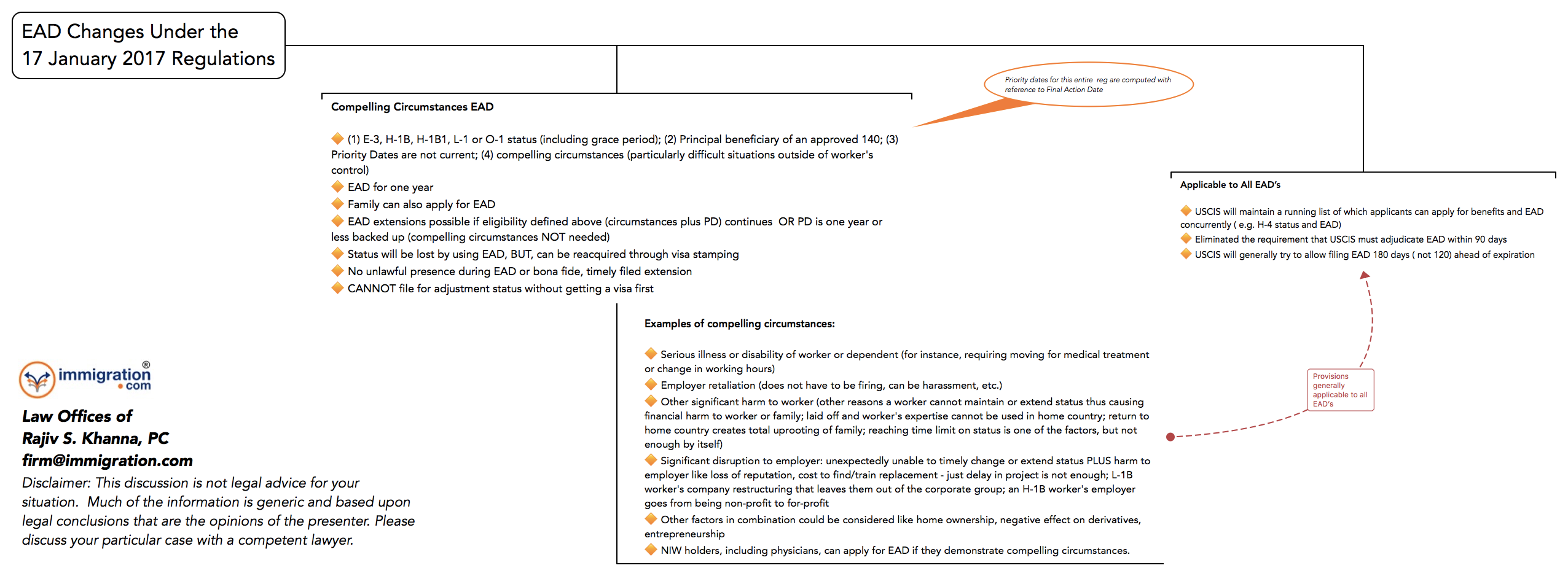
This entry is now old law. The new law is at http://www.immigration.com/blogs/i-140-ead-regulations-effective-17-jan…
Note: Updated all of the regulations comments on 31 December 2015. I will keep adding, as needed.
The Department of Homeland Security (DHS) amended its regulations today to improve the programs serving the H-1B1, E-3 and CW-1 nonimmigrant classifications and the EB-1 immigrant classification, and remove unnecessary hurdles that place such workers at a disadvantage when compared to similarly situated workers in other visa classifications.
Discussion Topics, Thursday, 28 January 2016:
FAQ: Conversion from H-1 to H-4 EAD and back to H-1 – H-1 quota; L-1B converting to H-1B change of status and quota; H-1 duration through a new employer after I-140 approved – starting a new green card – do job titles and job descriptions have to match; Reapplying for a B-2 visa after denial – importance of income; Filing B visa to maintain status – H-1 and H-1 extension durations when I-140 is approved – when I-140 is revoked – time USCIS takes to revoke an I-140; Visas for starting a restaurant business franchise in the USA.
Other: Changing jobs after returning on N-470; PERM approval after MTR/Appeal on harmless error/typo; Consequences of old employer withdrawing I-140; Limit on number of times one can apply for H-1; Porting priority date from an approved I-140 that was revoked for error; Entering to do business on a prior approved B-2 visa; L-1A and PERM based green cards; H-1 quota based upon prior approval.
The Department of Homeland Security (DHS) amended its regulations today to improve the programs serving the H-1B1, E-3 and CW-1 nonimmigrant classifications and the EB-1 immigrant classification, and remove unnecessary hurdles that place such workers at a disadvantage when compared to similarly situated workers in other visa classifications.
Topics for Discussion, Thursday, 25 February 2016:
FAQ: Can I travel during the pendency of my (B-1, B-2 extension, H-1, H-4, H-4 EAD, L-1, L-2, I-130, I-140, I-485, I-485, Advance Parole, Reentry Permit etc.) case? When should I join my future green card employer, also recapturing time on L-1B; Can a denied H-1B petition make you cap exempt; Special immigration options for UK citizens; How to correct errors on a submitted Form DS-260.
Other: Effect of abandoned change of status from F-2 to F-1; Time for non-premium processing of H-1B employer transfer and process for H-4; Green card or status for autistic son; CSPA for family-based children and disclosing pending immigration application when applying for a student visa; Changing employers after I-140; OCI; The new I-140 regulations; Status when H-1 is denied; Options for addressing H-1 processing delays; Affidavit of support from a person domiciled outside the USA; H-1B extensions based upon old employer’s I-140; Cross chargeability; H-1B quota exemption, etc.
US Work and Immigration Options for Foreign Professionals
The E-3 visa allows for the admission of an alien who is a national of the Commonwealth of Australia and who is entering the U.S. to perform services in a “specialty occupation.” The E-3 visa has many advantages over the other types of working visas, including the ability for spouses of E-3 recipients to apply for work authorization.
We assisted in responding to an RFE questioning the employer’s educational requirements for an E-3 (Specialty Occupation Workers from Australia) Petition filed for a software developer position. USCIS sought clarification as to how the position could be a specialty occupation where the employer required a minimum of a bachelor’s degree in business, information systems, computer science or equivalent with related experience.
We successfully assisted a new client in filing an E-2 visa extension. The applicant was a national of a treaty country and was the 100% shareholder of the U.S. enterprise. Through extensive documentation, including contracts, invoices, financial statements, and detailed explanations of the evidence, we were able to show that the U.S. enterprise was a real and operating enterprise, and that the applicant had made a substantial, qualifying investment in the enterprise and put his personal investment at risk.
We assisted in responding to an RFE questioning the employer’s educational requirements for an E-3 (Specialty Occupation Workers from Australia) Petition filed for a software developer position. USCIS sought clarification as to how the position could be a specialty occupation where the employer required a minimum of a bachelor’s degree in business, information systems, computer science or equivalent with related experience.
Discussion Topics, February 17, 2022
FAQ's: Left while Extension pending. B-1/B-2 visa inspection at the airport by the CBP and repercussions || Interfiling || Interfiling and AC21 Portability || Interfiling, Returning to Old Employer
Discussion Topics, Thursday, March 03, 2022:
FAQ: Abandonment; can I leave the USA while a change of status is pending?/Stamping requirements || Relation between F-1 status and I-485 AOS (child covered under Child Status Protection Act (CSPA)) || Relation between F-1 OPT and H-1B lottery change of status and changing employers || Is doing an unpaid U.S. externship/observership with F-2 visa unauthorized employment? || Can parents of U.S. citizens travel to the U.S. on an existing B-2 visa while their GC is pending?
Release Date
03/18/2022
U.S. Citizenship and Immigration Services is updating guidance in the USCIS Policy Manual to address the documentation that certain E and L nonimmigrant spouses may use as evidence of employment authorization based on their nonimmigrant status.
We filed an H-1B extension petition for a small software company that offers customer software and technology solutions to the local clientele. USCIS approved the classification portion of the petition, but denied the portion of the petition requesting an extension of stay. USCIS stated that beneficiary had failed to maintain his nonimmigrant status because his H-1B status had expired prior to the filing of the H-1B extension petition and he was only in an authorized period of stay because of a pending extension request from the previous employer.
We filed an H-1B extension petition for a software consulting and professional services firm on behalf of a software architect requesting status and work authorization for a duration of three years. The extension was, however, approved for a duration much shorter than requested and the approval notice was both dated and received after the shorter validity period had already expired, thereby destroying the legal status of the employee and causing him to accrue unlawful presence.
We successfully responded to an H-1B request for evidence (RFE), questioning the beneficiary’s maintenance of status. The beneficiary’s previous employer (Employer A) had submitted an H-1B extension. While the petition was pending the beneficiary’s nonimmigrant status expired. An RFE was subsequently received by Employer A, and following the filing of a comprehensive RFE response, the petition was denied.
We filed an H-1B extension for a specialized medical practice on behalf of a physician who had completed a fellowship in this specialty. We subsequently received a Request for Evidence questioning whether his position satisfied the requirements for a specialty occupation and questioning his current immigration status.