Guestbook Entry for Johnson Edwin Dodla , United States
Name
Johnson Edwin Dodla
Country
United States
State
PA


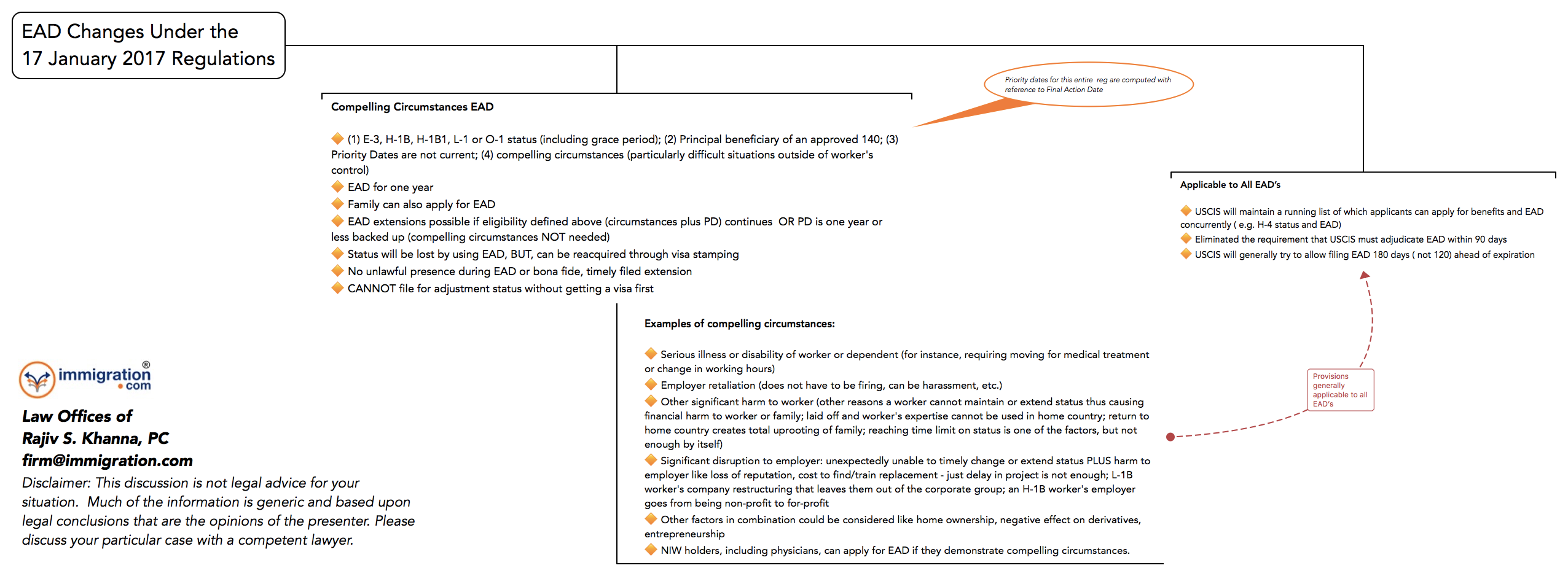
This entry is now old law. The new law is at http://www.immigration.com/blogs/i-140-ead-regulations-effective-17-jan…
Note: Updated all of the regulations comments on 31 December 2015. I will keep adding, as needed.
The Department of Homeland Security (DHS) amended its regulations today to improve the programs serving the H-1B1, E-3 and CW-1 nonimmigrant classifications and the EB-1 immigrant classification, and remove unnecessary hurdles that place such workers at a disadvantage when compared to similarly situated workers in other visa classifications.
The Department of Homeland Security (DHS) amended its regulations today to improve the programs serving the H-1B1, E-3 and CW-1 nonimmigrant classifications and the EB-1 immigrant classification, and remove unnecessary hurdles that place such workers at a disadvantage when compared to similarly situated workers in other visa classifications.
US Work and Immigration Options for Foreign Professionals
The E-3 visa allows for the admission of an alien who is a national of the Commonwealth of Australia and who is entering the U.S. to perform services in a “specialty occupation.” The E-3 visa has many advantages over the other types of working visas, including the ability for spouses of E-3 recipients to apply for work authorization.
We assisted in responding to an RFE questioning the employer’s educational requirements for an E-3 (Specialty Occupation Workers from Australia) Petition filed for a software developer position. USCIS sought clarification as to how the position could be a specialty occupation where the employer required a minimum of a bachelor’s degree in business, information systems, computer science or equivalent with related experience.
We assisted in responding to an RFE questioning the employer’s educational requirements for an E-3 (Specialty Occupation Workers from Australia) Petition filed for a software developer position. USCIS sought clarification as to how the position could be a specialty occupation where the employer required a minimum of a bachelor’s degree in business, information systems, computer science or equivalent with related experience.
Release Date
03/18/2022
U.S. Citizenship and Immigration Services is updating guidance in the USCIS Policy Manual to address the documentation that certain E and L nonimmigrant spouses may use as evidence of employment authorization based on their nonimmigrant status.
31 March 2022
| Forms |
Response Time |
Premium Processing Fee |
Expected Implementation Time |
|---|---|---|---|
|
Most Form I-140 EB-1, EB-2, and EB-3 petitions |
We assisted our client, a nonprofit religious organization, in filing a nonimmigrant religious worker (R-1) petition for a new pastor. We received a Request for Evidence (RFE) in which USCIS questioned the petitioner's ability to compensate the beneficiary. We responded with additional documentation supporting Petitioner’s ability to pay and its nonprofit status, such as bank statements and a final determination letter granting tax-exempt status as issued by the IRS. The case was approved.
USCIS recently updated the following form:
Form I-907, Request for Premium Processing Service
05/31/2022 10:01 AM EDT
Edition Date: 05/31/22. Starting July 1, 2022, USCIS will only accept the 05/31/22 edition. Until then, you can also use the 09/30/20 edition. You can find the edition date at the bottom of the page on the form and instructions.
For more information, please visit the Forms Updates page.
Discussion Topics:
Discussion Topics, Thursday, Sept 16, 2021
FAQ: Consequences of extending parents’ B-1/B-2 (visitors/tourist) status more than once||Consequences of green card holders staying outside the USA for an extended time. Reentry permit protection ||Applied for EB-3 downgrade and change of employer after 180 days while I-140 is pending
Release Date
08/30/2022
U.S. Citizenship and Immigration Services (USCIS) is issuing policy guidance in the USCIS Policy Manual to reorganize and expand on existing guidance related to special immigrant and nonimmigrant religious workers.
This update reorganizes the special immigrant religious worker guidance for clarity and provides more comprehensive information about the special immigrant religious worker filing process, verification of evidence, and the site-inspection process.
SUBSCRIBE to Immigration.com YouTube Channel for further updates.
Immigration.com, Law Offices of Rajiv S. Khanna PC, US Immigration Attorney
Rajiv Khanna Blog: http://www.immigration.com/blogs
Twitter: https://twitter.com/immigrationcom
Facebook: https://www.facebook.com/immigrationd...
Linkedin: http://www.linkedin.com/in/rajivskhanna
YouTube: http://www.youtube.com/immigrationdotcom
Contact Us : (202)909-1110, help@immigration.com
Address: 5225 Wilson Blvd., Arlington, VA 22205
---------------
FREE US Immigration Help We host free community conference call every other Thursday. Anyone is welcome to call in. Details are at: http://www.immigration.com/us-immigra...
To post questions for community calls, visit our forums at https://forums.immigration.com/forums..

Radio Show Discussing Overview of the new I-140 EAD Regulations
Discussing I-140 EAD FAQ in community conference call
On April 7, 2015, the U.S. Court of Appeals for the Third Circuit, in Shalom Pentecostal Church v. Acting Secretary DHS, 783 F.3d 156 (3d Cir. 2015), found the regulatory requirements that qualifying work experience gained in the United States must have been acquired in lawful status (herein “lawful status requirements”) in 8 CFR 204.5(m)(4) and (11) to be beyond the Department’s legal authority (ultra vires). The court found that the statute was clear and unambiguous and that the regulation was inconsistent with the statute.
FAQs: Religious Worker Visa, premises still under construction || Students aging out of H-4 || Lawsuit against status denial for CPT users || AC21 portability Supplement J || L-1 and entrepreneurial H-1B || 60 days grace period of H-1B getting over - F-1 option || Need to amend H-1B for remote work from home || Part time H-1B || Doing business on OPT
OTHER: IR5 Green Card traveling separately || H-1B Quota exemption || Reentry Permit obligations || H-1B change of status || CSPA for child of EB-1A petitioner || 212(e) waivers for J-1 holders || I-140 withdrawal || H-4 EAD processing times ||
USCIS announced that individuals with a pending Form I-360 religious worker petition with USCIS, may be eligible for benefits under Ruiz-Diaz v. United States, No. C07-1881RSL (W.D. Wash. June 11, 2009). To see the USCIS notice and the court issued notice in Ruiz-Diaz v. US, No. C07-1881RSL, see attachment.