
Search
USCIS to Begin Implementing New Policy Memorandum on Notices to Appear
U.S. Citizenship and Immigration Services (USCIS) will begin implementing the June 28 Updated Guidance for the Referral of Cases and Issuance of Notices to Appear (NTAs) in Cases Involving Inadmissible and Deportable Aliens Policy Memorandum (PM) (PDF, 140 KB) on Oct. 1, 2018. USCIS will take an incremental approach to implement this memo.
F-1 “Cap-gap” Status and Work Authorization Extension Only Valid Through Sept. 30, 2018
F-1 students who have an H-1B petition that remains pending on Oct. 1, 2018, risk accruing unlawful presence if they continue to work on or after Oct. 1 (unless otherwise authorized to continue employment), as their “cap-gap” work authorization is only valid through Sept. 30.
USCIS Workload Transfer Updates
USCIS transferred some of the following cases from the Vermont Service Center to the Texas Service Center:
- Form I-539, Application to Extend/Change Nonimmigrant Status, for F, M, J, or B nonimmigrants
For more information, see Workload Transfer Updates page.
Workload Transfer Update
USCIS transferred some of the following cases from the Vermont Service Center to the Texas Service Center, Nebraska Service Center, California Service Center, and Potomac Service Center:
- Form I-539, Application to Extend/Change Nonimmigrant Status, for F, M, J, or B nonimmigrants
For more information, see Workload Transfer Updates page.
Jan 24, 2019, Recording of Free Community Conference Call (Every Other Thursday)
Immigration.com
Nonimmigrant Visas
Green Card
Discussion Topics, Thursday, 24 January 2019:
FAQ: Green Card portability for EB-1C international managers or executives||What is the advantage of EB2 over EB3 category?|| Difference between final action dates for employment-based preference cases b. Dates for filing of employment-based visa applications ||
Other: Consequences of moving locations for H-1B and green card cases ||Green card through marriage||H-1B approval beyond six years based upon I-140 approval of another employer||Defining same or similar job for AC 21 portability||Cross chargeability||Converting from EB-2 to EB-3 ||Doing business on H-1B ||Changing employers from nonprofit to for-profit ||Rejoining an old job after a denial of an H-1B transfer||Difference between AC 21 portability and 240 days regulation to continue working on H-1B ||When is a Supplement J required?
May 10, 2018 Recording of Free Community Conference Call (Every Other Thursday)
Immigration.com
Citizenship and Naturalization
Nonimmigrant Visas
Green Card
FAQs: - Effect of I-140 revocation on priority date - H-1B extensions through any employer - Is there any law to provide legal stay to the parent of US citizen child with disability? - Status of off-site placed STEM OPT extension students - how does one change status while within the United States?
USCIS Changing Policy on Accrued Unlawful Presence by Nonimmigrant Students and Exchange Visitors
WASHINGTON—U.S. Citizenship and Immigration Services (USCIS) today posted a policy memorandum (PDF, 179 KB)changing how the agency will calculate unlawful presence for students and exchange visitors in F, J, and M nonimmigrant status, including F-2, J-2, or M-2 dependents, who fail to maintain their status in the United States.
May 24, 2018, Recording of Free Community Conference Call (Every Other Thursday)
Immigration.com
Citizenship and Naturalization
Nonimmigrant Visas
Green Card
The Proposed I-140 EAD Rule - Continually Updated

This entry is now old law. The new law is at http://www.immigration.com/blogs/i-140-ead-regulations-effective-17-jan…
Note: Updated all of the regulations comments on 31 December 2015. I will keep adding, as needed.
Recording of Free Community Conference Call (Every Other Thursday), 14 January 2016
Citizenship and Naturalization
Green Card
Discussion Topics, Thursday, 14 January 2016:
FAQ: Percentage arrangement for salary; Naturalization (citizenship) after lengthy stay abroad; H-1 6 years expiring, options; H-1 Cap exemption, visa stamped, but never worked; FAQ: Can I apply for H-4 visa if H-1 visa is rejected; can I convert from H-4 to H-1; Filing multiple PERM/green card petitions; Green card EB-1C international executive or manager, L-1A.
Other: Entering USA close to visa expiration; L-1B to L-1A and PERM; Transfer of priority date, green card through future employment, H-4 EAD based upon old employer’s I-140; H-4 EAD applying for green card, extending H-1; H-4 to H-1 conversion; Green card through future employer; Green card job duties, job title, promotion; G-315a RFE; Affidavit of birth; H-4 EAD and Change of Status; Priority date transfer, etc.
DHS Enhances Opportunities for H-1B1, E-3, CW-1 Nonimmigrants and Certain EB-1 Immigrants, Final Rule Posted
The Department of Homeland Security (DHS) amended its regulations today to improve the programs serving the H-1B1, E-3 and CW-1 nonimmigrant classifications and the EB-1 immigrant classification, and remove unnecessary hurdles that place such workers at a disadvantage when compared to similarly situated workers in other visa classifications.
DHS Enhances Opportunities for H-1B1, E-3, CW-1 Nonimmigrants and Certain EB-1 Immigrants, Final Rule Posted
The Department of Homeland Security (DHS) amended its regulations today to improve the programs serving the H-1B1, E-3 and CW-1 nonimmigrant classifications and the EB-1 immigrant classification, and remove unnecessary hurdles that place such workers at a disadvantage when compared to similarly situated workers in other visa classifications.
US Work and Immigration Options for Foreign Professionals
US Work and Immigration Options for Foreign Professionals
A discussion with two members of our community
E-3 Visa
Overview
The E-3 visa allows for the admission of an alien who is a national of the Commonwealth of Australia and who is entering the U.S. to perform services in a “specialty occupation.” The E-3 visa has many advantages over the other types of working visas, including the ability for spouses of E-3 recipients to apply for work authorization.
Nonimmigrant Visas
Outline of Compelling Circumstances EAD Regs
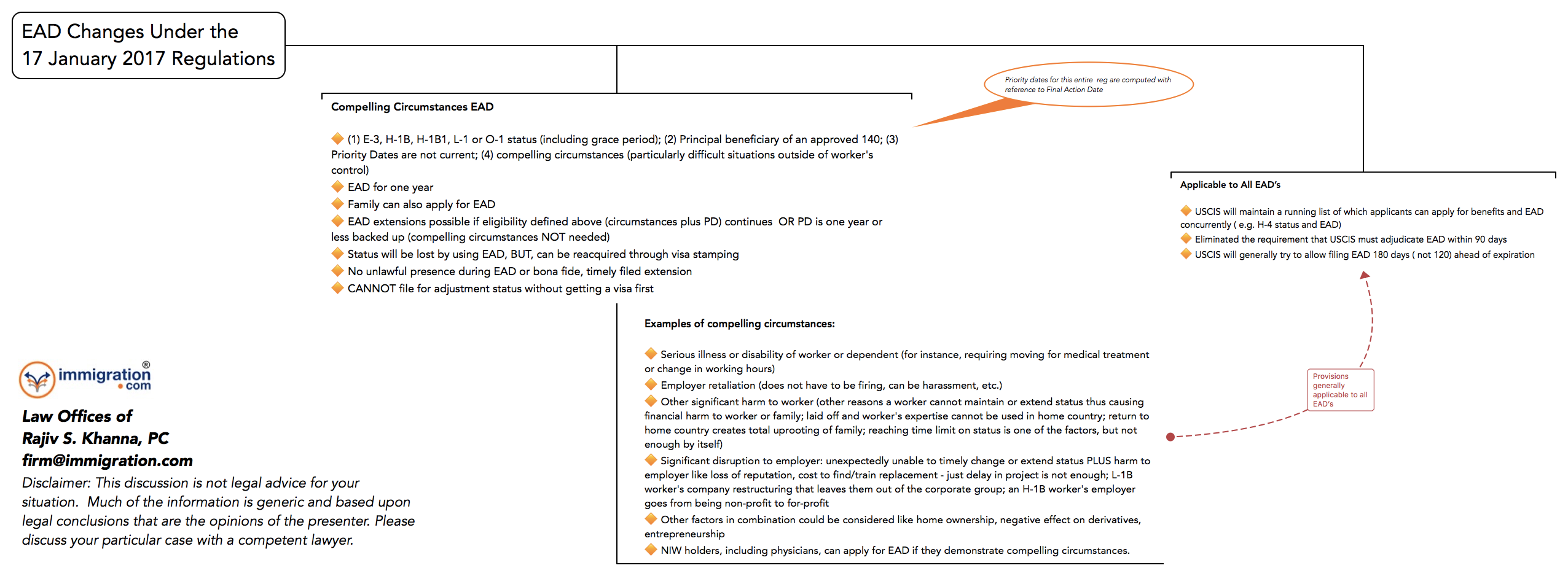
Green Card
Oct 3, 2019 Recording of Free Community Conference Call (Every Other Thursday)
Immigration.com
Citizenship and Naturalization
Nonimmigrant Visas
Green Card
Discussion Topics, Thursday, October 3, 2019
FAQ: When should we file Supplement J for AC21 || Changing employers after 180 days of I-140 approval || Filing an I-485 for a junior position when already promoted || Expediting H-4 EAD || Is there a correlation between processing times and priority dates? || Traveling while H-4 EAD extension is pending.
OTHER: 60 days grace period between H-1B petitions || Options for alleged OPT/CPT violations || Requiring pay stubs from a retired Veteran || Changing employers after 180 days of I-140 approval || Is there a deadline for filing I-485 after PD is current || Financial issues in sponsorship || Public charge rule || Refiling N-400 || Applying for H-1B extension while outside the USA || H-1B/EAD options || EB-1A changing jobs/multiple categories green cards pending || Indian OCI cards, etc.
Recording of Free Community Conference Call (Every Other Thursday), June 1, 2017
Immigration.com
Nonimmigrant Visas
Immigration Law
Green Card
Success in responding to a Request for Evidence after filing an E-3 Petition
We assisted in responding to an RFE questioning the employer’s educational requirements for an E-3 (Specialty Occupation Workers from Australia) Petition filed for a software developer position. USCIS sought clarification as to how the position could be a specialty occupation where the employer required a minimum of a bachelor’s degree in business, information systems, computer science or equivalent with related experience.
Nonimmigrant Visas
Agency
Immigration Law
Success in responding to a Request for Evidence after filing an E-3 Petition
We assisted in responding to an RFE questioning the employer’s educational requirements for an E-3 (Specialty Occupation Workers from Australia) Petition filed for a software developer position. USCIS sought clarification as to how the position could be a specialty occupation where the employer required a minimum of a bachelor’s degree in business, information systems, computer science or equivalent with related experience.
March 03, 2022 Free US Immigration Community Conference Call with Rajiv (Every Other Thursday)
Immigration.com
Nonimmigrant Visas
Discussion Topics, Thursday, March 03, 2022:
FAQ: Abandonment; can I leave the USA while a change of status is pending?/Stamping requirements || Relation between F-1 status and I-485 AOS (child covered under Child Status Protection Act (CSPA)) || Relation between F-1 OPT and H-1B lottery change of status and changing employers || Is doing an unpaid U.S. externship/observership with F-2 visa unauthorized employment? || Can parents of U.S. citizens travel to the U.S. on an existing B-2 visa while their GC is pending?
USCIS Updates Guidance on Employment Authorization for E and L Nonimmigrant Spouses
Release Date
03/18/2022
U.S. Citizenship and Immigration Services is updating guidance in the USCIS Policy Manual to address the documentation that certain E and L nonimmigrant spouses may use as evidence of employment authorization based on their nonimmigrant status.
H-1B extension and change in employer filed while out of status
We successfully responded to an H-1B request for evidence (RFE), questioning the beneficiary’s maintenance of status. The beneficiary’s previous employer (Employer A) had submitted an H-1B extension. While the petition was pending the beneficiary’s nonimmigrant status expired. An RFE was subsequently received by Employer A, and following the filing of a comprehensive RFE response, the petition was denied.
Nonimmigrant Visas
Immigration Law
27 May 2021: Free US Immigration Community Conference Call with Rajiv (Every Other Thursday)
Immigration.com
Citizenship and Naturalization
Nonimmigrant Visas
Immigration Law
Green Card
Discussion Topics, Thursday, May 27, 2021
FAQ: Not reporting change of address to the USCIS - Naturalization || Chances of getting an F-1 Visa when B-1 Visa was rejected earlier 214(b) denial